
Resilience4j: Fault Tolerance Library for Java Applications
Resilience4j is a lightweight fault tolerance library designed for Java 8 and functional programming. It provides higher-order functions to enhance any functional interface with resilience patterns including Circuit Breaker, Retry, Rate Limiter, Bulkhead, Time Limiter, Cache, and Fallback.
Resilience4j: Fault Tolerance Library for Java Applications
Resilience4j is a lightweight fault tolerance library designed for Java 8 and functional programming. It provides higher-order functions, or decorators, that enhance any functional interface, lambda expression, or method reference with resilience patterns. Unlike other fault tolerance libraries that rely on thread pools and annotations, Resilience4j takes a functional approach, making it lightweight and easy to use with modern Java applications.
In distributed systems, failures are inevitable. Resilience4j helps build applications that handle failures gracefully. To understand Resilience4j properly, it helps to be familiar with the retry pattern, circuit breaker pattern, and microservices architecture.
What Is Resilience4j?
Resilience4j is a fault tolerance library inspired by Netflix Hystrix but designed for Java 8 and functional programming. It provides several resilience patterns that help applications handle failures, control latency, and maintain stability in distributed systems.
- Lightweight: Unlike Hystrix which has its own thread pools, Resilience4j uses functional programming and is lightweight with no external dependencies.
- Modular: You only include the modules you need, keeping your application lean.
- Functional: Decorators can be stacked on lambda expressions and method references.
- Observable: Built-in support for metrics and event publishing.
- Vavr Integration: Works seamlessly with Vavr functional types.
Resilience4j Modules
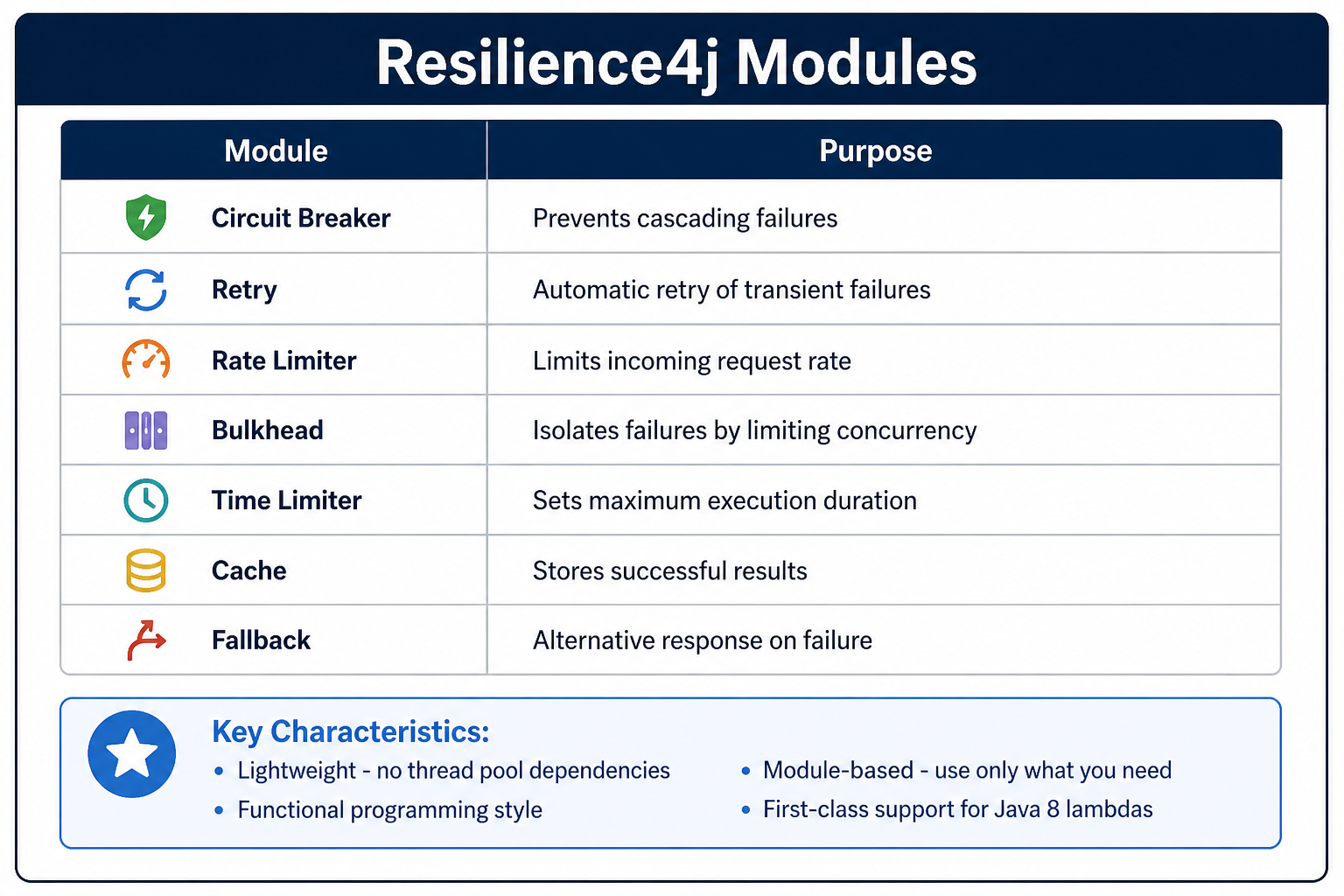
Resilience4j is divided into several independent modules, each implementing a specific resilience pattern. You can use them individually or combine them for comprehensive fault tolerance.
| Module | Purpose | When to Use |
|---|---|---|
| Circuit Breaker | Prevents cascading failures by temporarily blocking calls to failing services | When a service is unstable or failing consistently |
| Retry | Automatically repeats failed operations for transient failures | For network timeouts, database deadlocks, or temporary unavailability |
| Rate Limiter | Limits the rate of incoming requests to prevent overload | To protect APIs from excessive traffic or abuse |
| Bulkhead | Limits concurrent executions to isolate failures | To prevent one service from exhausting application resources |
| Time Limiter | Sets a maximum duration for operation execution | To enforce deadlines and prevent hanging operations |
| Cache | Stores successful results for reuse | For frequently requested, slow-changing data |
| Fallback | Provides alternative results when operations fail | To maintain functionality when dependencies are unavailable |
Circuit Breaker Module
The Circuit Breaker pattern prevents cascading failures by temporarily blocking calls to a service that is failing. Circuit breakers have three states: CLOSED (normal operation), OPEN (failing fast), and HALF_OPEN (testing if service recovered). When failures exceed a threshold, the circuit opens. After a timeout, it transitions to HALF_OPEN where a successful call closes it, while a failure keeps it open. This pattern is discussed in detail in our circuit breaker pattern guide.
Circuit Breaker Configuration Options
- failureRateThreshold: Percentage of failures required to open the circuit, typically 50 percent.
- slidingWindowSize: Number of calls to analyze for failure rate calculation.
- waitDurationInOpenState: Time circuit stays open before transitioning to HALF_OPEN.
- permittedNumberOfCallsInHalfOpenState: Number of test calls allowed while half open.
- slowCallRateThreshold: Percentage of slow calls that counts as failures.
- slowCallDurationThreshold: Duration threshold for considering a call slow.
Retry Module
The Retry module automatically repeats failed operations for transient failures that may self-correct after a short delay. Many faults in distributed systems, such as network timeouts or database deadlocks, are temporary and retrying can turn a failure into a success. This module is explored in depth in our retry pattern guide.
Retry Configuration Options
- maxAttempts: Maximum number of attempts including the initial call. Default is 3.
- waitDuration: Fixed duration to wait between retries. Default is 500 milliseconds.
- intervalFunction: Function to calculate wait time based on attempt number for backoff strategies.
- retryExceptions: Exception classes that should trigger a retry.
- ignoreExceptions: Exception classes that should never trigger a retry.
- retryOnResult: Predicate to determine which result values should trigger a retry.
Backoff Strategies
Resilience4j provides multiple strategies for calculating wait intervals between retries:
- Fixed Interval: Same waiting time between each retry. Simple but can overwhelm struggling services.
- Randomized Interval: Adds randomness to the base interval. Helps avoid synchronized retries in distributed systems, known as the thundering herd problem.
- Exponential Backoff: Increases waiting time exponentially after each retry. Ideal for transient failures that resolve with time.
- Exponential Random Backoff: Combines exponential growth with randomization. Best for load-related failures in distributed systems.
Rate Limiter Module
The Rate Limiter module limits the rate of incoming requests to prevent overload. It ensures that a service does not receive more requests than it can handle, protecting both the service and downstream dependencies.
- limitForPeriod: Number of requests permitted per time period.
- limitRefreshPeriod: Duration of the rate limiting period.
- timeoutDuration: Maximum time a caller waits for a rate limiter permit.
Bulkhead Module
The Bulkhead pattern limits the number of concurrent executions to isolate failures. Named after ship compartments that prevent flooding, bulkheads ensure that failure in one service component does not consume all application resources.
- maxConcurrentCalls: Maximum number of parallel executions allowed.
- maxWaitDuration: Maximum time a caller waits for a bulkhead permit.
Resilience4j offers two bulkhead implementations: SemaphoreBulkhead, which uses semaphores and is lightweight, and ThreadPoolBulkhead, which uses bounded queues and thread pools for more control.
Time Limiter Module
The Time Limiter sets a maximum duration for operation execution. If an operation takes longer than the configured timeout, it is cancelled. Beyond a certain wait interval, a successful result is unlikely, so failing fast is better than waiting indefinitely.
- timeoutDuration: Maximum duration allowed for operation execution.
- cancelRunningFuture: Whether to cancel running futures on timeout.
Cache Module
The Cache module stores successful results to serve subsequent identical requests without re-executing the operation. Some proportion of requests may be similar, and caching reduces latency and computational load.
Fallback Module
The Fallback module provides alternative results when operations fail. Things will still fail, so you should plan what to do when that happens. Fallbacks can return default values, retrieve from cache, or call alternative services.
Stacking Decorators
One of Resilience4j's most powerful features is the ability to stack multiple decorators on a single operation. You can combine Retry, Circuit Breaker, Rate Limiter, Bulkhead, and Time Limiter in any order.
A typical stacking order from outermost to innermost might be: Rate Limiter first to reject excessive traffic, then Bulkhead to control concurrency, then Circuit Breaker to prevent calls to failing services, then Retry for transient failures, then Time Limiter for deadline enforcement. The order depends on your specific requirements, and different applications may need different stacking strategies.
Event Publishing and Metrics
Resilience4j provides built-in support for event publishing and metrics. Each module emits events for important state changes, such as circuit breaker state transitions, retry attempts, rate limit acquisitions, and bulkhead permit releases.
- Event Publisher: Register event consumers to log, monitor, or trigger actions on resilience events.
- Metrics: Each module exposes metrics for monitoring success rates, failure rates, call counts, and state durations.
- Micrometer Integration: Export metrics directly to monitoring systems like Prometheus and Grafana.
Spring Boot Integration
Resilience4j integrates seamlessly with Spring Boot. You can configure resilience patterns using application properties or YAML files, and use annotations to decorate Spring beans with resilience features.
resilience4j:
  circuitbreaker:
    instances:
      backend-service:
        failure-rate-threshold: 50
        sliding-window-size: 100
        wait-duration-in-open-state: 10s
  retry:
    instances:
      backend-service:
        max-attempts: 3
        wait-duration: 1s
  ratelimiter:
    instances:
      backend-service:
        limit-for-period: 100
        limit-refresh-period: 1s
  bulkhead:
    instances:
      backend-service:
        max-concurrent-calls: 25
Resilience4j vs Alternative Libraries
| Aspect | Resilience4j | Netflix Hystrix | Sentinel |
|---|---|---|---|
| Architecture | Functional, lightweight | Thread pool based | Flow control based |
| Support Status | Active maintenance | Retired (in maintenance mode) | Active |
| Java Version | Java 8+ with functional style | Java 7+ | Java 8+ |
| Ecosystem | Spring Boot 2 and 3 | Spring Cloud Netflix | Spring Cloud Alibaba |
Best Practices
- Stack Decorators Carefully: The order matters. Rate limiter before bulkhead before circuit breaker before retry is a common pattern.
- Configure Distinct Instances: Different services have different failure characteristics. Create separate instances for each dependency rather than sharing configurations.
- Monitor Events: Always wire event publishers to logging and monitoring systems. Understanding why your circuit breakers open or retries happen is essential for incident response.
- Use Falling Back Gracefully: Always provide fallbacks for critical operations. Returning a default value or cached response is better than failing completely.
- Set Realistic Timeouts: Time limiter durations should be based on actual observed latencies, not arbitrary values.
- Start with Defaults Then Tune: Resilience4j defaults are sensible for many cases but monitor and adjust based on production metrics.
- Test Failure Scenarios: Use chaos testing to verify your resilience configurations work as expected when dependencies fail.
- Combine with Retry and Circuit Breaker: Retry handles transient failures; circuit breaker prevents persistent failures from causing cascading issues. Use both.
Frequently Asked Questions
- What is the difference between Resilience4j and Hystrix?
Resilience4j is the successor to Netflix Hystrix, which is now in maintenance mode. Resilience4j is lighter, uses functional programming instead of thread pools, and has active development. It also has a more modular design, allowing you to use only the patterns you need. - Is Resilience4j only for microservices?
No. While popular in microservices architectures, Resilience4j can be used in any Java application that makes remote calls, accesses databases, or performs operations that may fail transiently. Monolithic applications making external API calls benefit equally. - Can I use Resilience4j with reactive programming?
Yes. Resilience4j provides dedicated modules for reactive stacks including RxJava and Reactor. These modules allow you to decorate reactive types like Flux and Mono with resilience patterns. - How do I choose between Retry and Circuit Breaker?
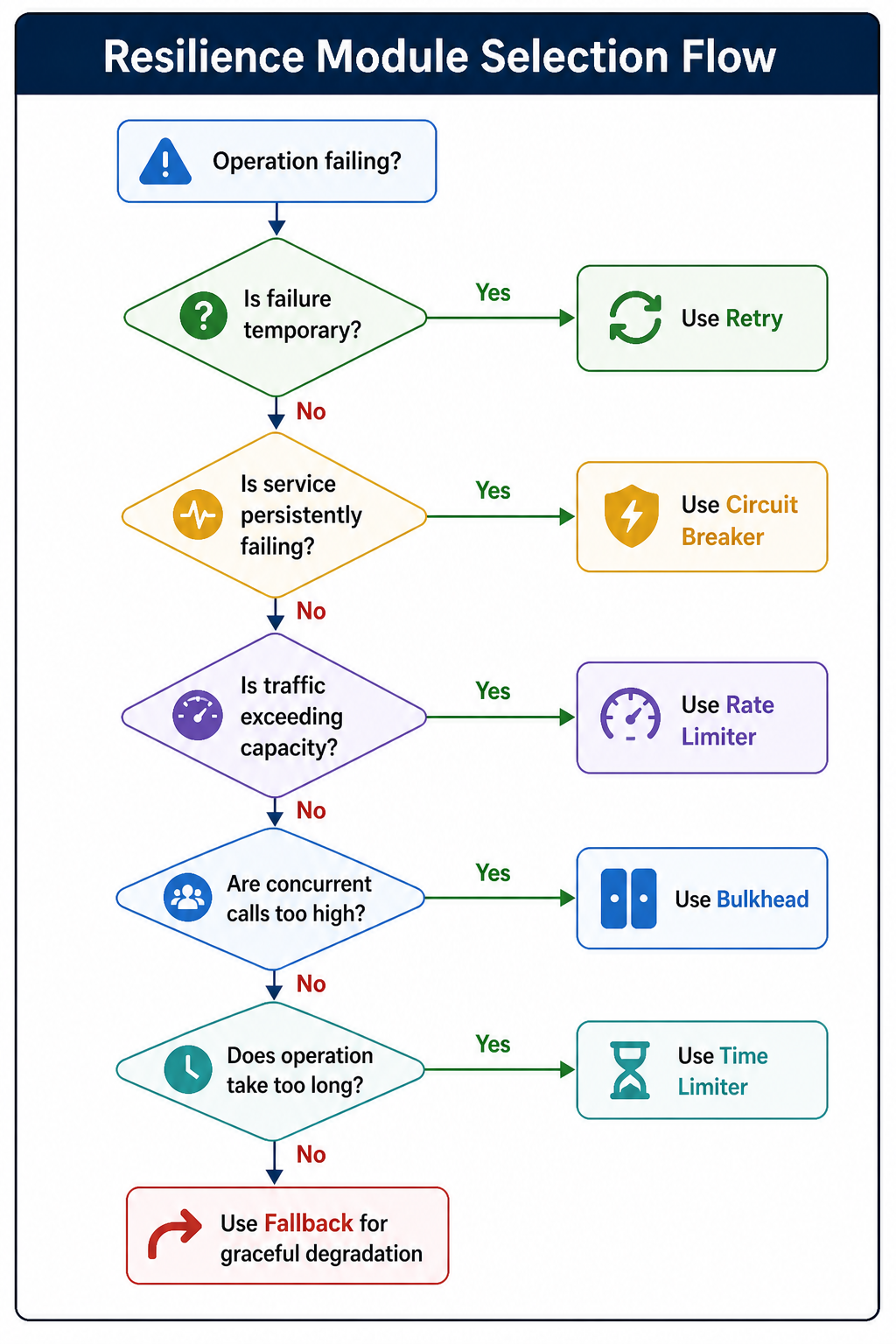
Use Retry for transient failures that are likely to succeed quickly, such as a momentary network glitch. Use Circuit Breaker for persistent failures where retrying would waste resources and delay failure detection. In practice, use both: retry for a few attempts, then circuit breaker opens if retries continue failing. - What is the difference between SemaphoreBulkhead and ThreadPoolBulkhead?
SemaphoreBulkhead uses semaphores to limit concurrent calls within the same thread pool. It is lightweight and sufficient for most cases. ThreadPoolBulkhead uses separate thread pools for isolation, providing better separation but higher overhead. Use SemaphoreBulkhead for I/O-bound operations and ThreadPoolBulkhead when you need strict thread isolation. - What should I learn next after Resilience4j?
After mastering Resilience4j, explore circuit breaker internals, advanced retry strategies, microservices architecture, distributed tracing for debugging, and containerization for deployment.