
Microservices Architecture: From Monolith to Distributed Systems
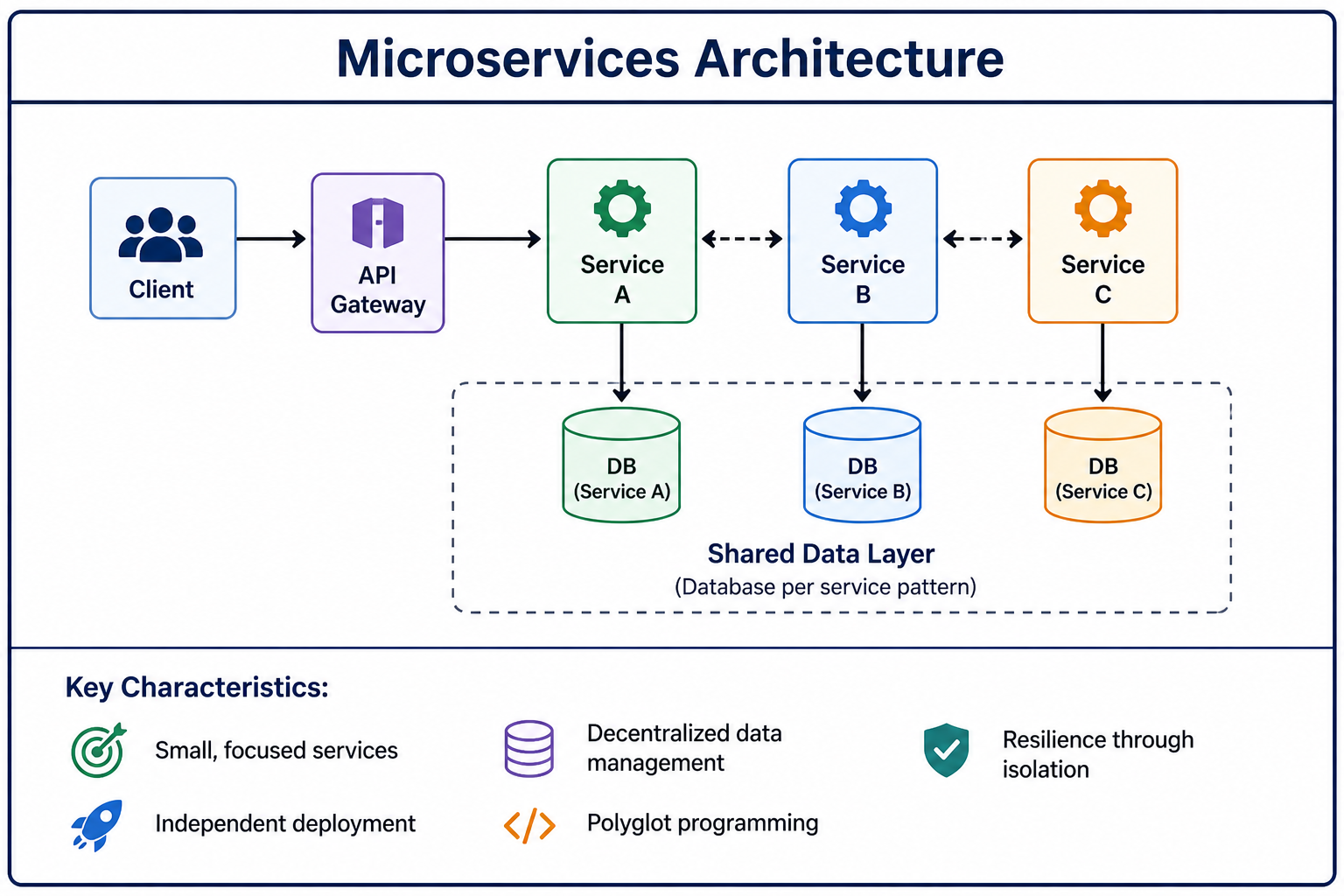
Microservices is an architectural style where an application is composed of small, independent services that communicate over a network. Each service focuses on a specific business capability and can be developed, deployed, and scaled independently.
Microservices Architecture: From Monolith to Distributed Systems
Microservices is an architectural style that structures an application as a collection of small, independent services. Each service runs its own process, communicates over a network, typically HTTP or messaging, and focuses on a specific business capability. Unlike traditional monolithic applications where all code is deployed together, microservices can be developed, deployed, scaled, and maintained independently.
The microservices approach has gained popularity as organisations move away from large, complex monoliths to more agile, scalable systems. To understand microservices properly, it helps to be familiar with the client-server model, REST APIs, and containerization technologies like Docker.
What Are Microservices?
Microservices, or microservices architecture, is an approach to software development where a large application is built as a suite of small, independent services. Each service runs in its own process and communicates with others through lightweight mechanisms, often HTTP APIs or message brokers.
- Single Responsibility: Each service does one thing and does it well.
- Independently Deployable: You can update one service without redeploying the whole application.
- Decentralised Data: Each service owns its own database.
- Technology Agnostic: Different services can use different programming languages and frameworks.
- Business-Aligned: Services are organised around business capabilities, not technical layers.
- Resilient by Design: Failure in one service does not necessarily crash the entire system.
Monolith vs Microservices
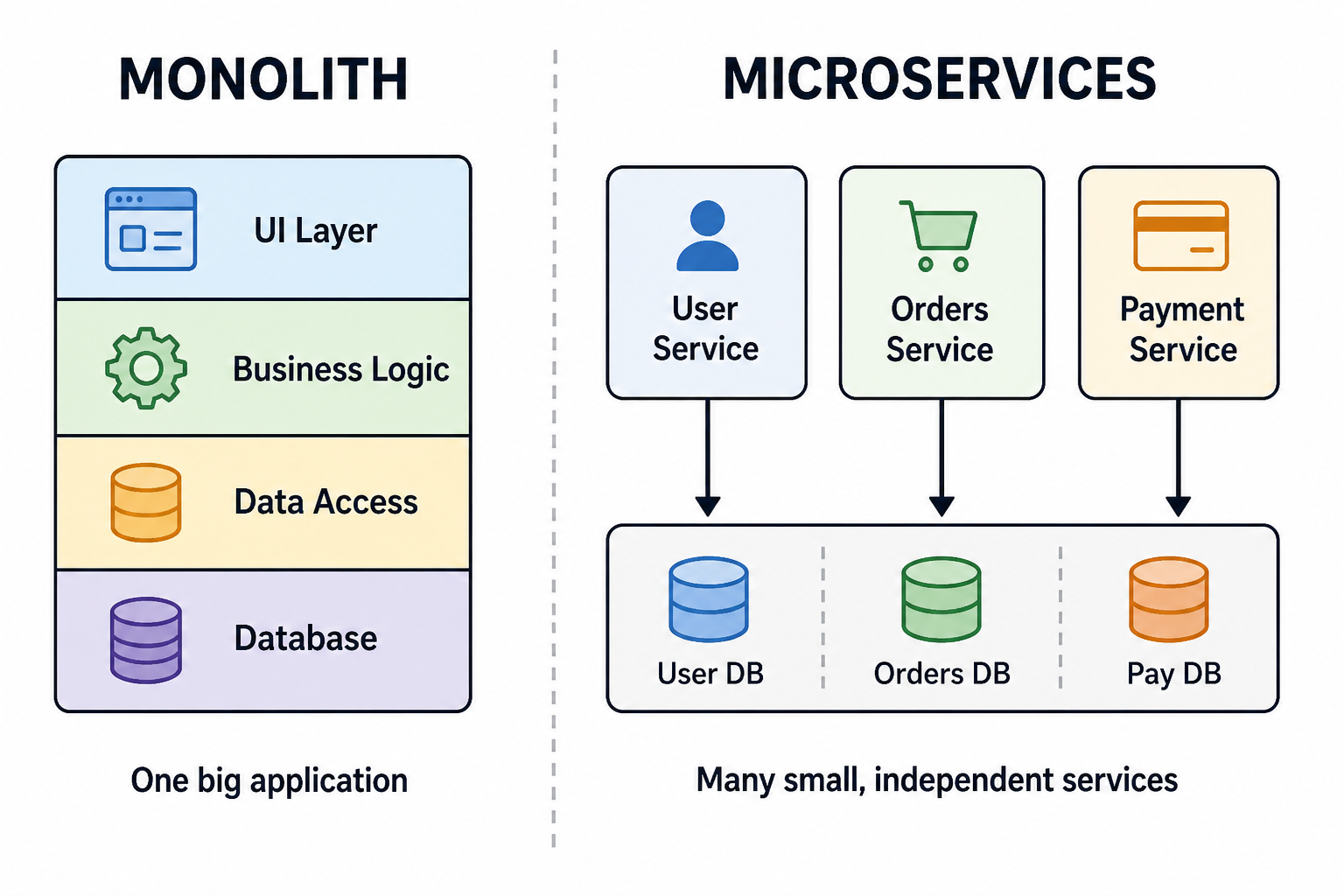
To understand microservices, you first need to understand what they replace: the monolithic architecture. A monolith is a single, unified codebase where all functionality runs in one process. Both approaches have trade-offs.
| Aspect | Monolithic Architecture | Microservices Architecture |
|---|---|---|
| Deployment | One large deployment per release | Individual service deployments |
| Scaling | Scale entire application | Scale only services that need it |
| Development | Single codebase, one team or many teams working together | Multiple teams can work independently |
| Technology | One technology stack for everything | Polyglot, mix of languages and tools |
| Fault Isolation | One bug can crash everything | Failure isolated to one service |
| Complexity | Simple to develop initially, complex at scale | Complex from the start as a distributed system |
Monolith vs Microservices
Core Microservices Concepts
1. Service Independence
Each microservice can be developed, deployed, and scaled independently. A team working on the payment service does not need to coordinate with the team working on the user service. This enables faster development cycles and organisational agility.
2. Database Per Service
Unlike monoliths where all services share a single database, microservices follow the database per service pattern. Each service owns its data and no other service can access it directly. This prevents tight coupling between services.
3. API Gateway
An API Gateway acts as a single entry point for all clients. It routes requests to the appropriate microservice, handles authentication, rate limiting, logging, and response aggregation. This pattern is covered in detail in our reverse proxy guide.
4. Service Discovery
In a microservices environment, services come and go dynamically, especially when using containers. Service discovery allows services to find each other without hardcoded IP addresses. Tools like Consul, etcd, or Kubernetes built-in DNS handle this.
5. Circuit Breaker Pattern
When one service calls another, failures can cascade. The circuit breaker pattern prevents this by stopping requests to a failing service, allowing it time to recover.
Communication Between Microservices
Synchronous Communication
Services call each other directly and wait for a response. This is simple but creates temporal coupling because the caller must wait. REST APIs over HTTP are the most common approach, with gRPC as a high-performance alternative.
Asynchronous Communication
Services communicate via messages without waiting for a response. This decouples services and improves resilience. Common tools include RabbitMQ, Apache Kafka, and AWS SQS. A service publishes an event, and other services consume it when ready.
Benefits of Microservices
- Independent Deployments: Fix a bug in one service and deploy just that service without full application redeployment.
- Technology Flexibility: Use different programming languages and frameworks for different services based on their needs.
- Focused Teams: Small teams own small services with less coordination overhead.
- Scalability: Scale only the services that need more resources rather than the entire application.
- Faster Development: Smaller codebases are easier to understand, test, and modify.
- Fault Isolation: If one service crashes, other services continue working.
- Easier Refactoring: Rewrite a single service without touching the rest of the system.
Challenges of Microservices
- Distributed System Complexity: Network latency, partial failures, and eventual consistency become real problems.
- Data Consistency: No shared database means no ACID transactions across services. You need eventual consistency and patterns like Saga.
- Debugging Difficulty: A single request can span multiple services. Distributed tracing becomes essential.
- Operational Overhead: You manage many services instead of one. Containerization and orchestration add complexity.
- Inter-service Communication: Network calls are slower than in-method calls. You must design for latency.
- Testing Complexity: Integration tests require running multiple services together.
When to Use Microservices
| Good Fit for Microservices | Better to Stay Monolithic |
|---|---|
| Large applications with many teams | Small applications or MVPs |
| Parts of system have different scaling needs | Tight development deadlines |
| Organisation planning to scale engineering teams | Team lacks DevOps and operations experience |
| Need for polyglot technology stack | Strong ACID transaction requirements across all features |
| Long-term investment project | Simple CRUD application |
Common Microservices Patterns
1. Saga Pattern for Data Consistency
Since you cannot use distributed transactions across services, the Saga pattern breaks a transaction into a series of local transactions. If one step fails, compensating transactions undo the previous steps. This ensures eventual consistency across services.
2. CQRS Pattern
Command Query Responsibility Segregation separates read and write operations into different models. This allows you to optimise each side independently and is particularly useful when read and write workloads have different requirements.
3. Event Sourcing
Instead of storing only the current state, event sourcing stores every state change as an event. The current state is derived by replaying events. This provides audit trails and enables temporal queries.
4. Strangler Pattern
This pattern helps migrate from a monolith to microservices gradually. New features are built as microservices, and over time, pieces of the monolith are replaced. Eventually, the monolith is completely "strangled" and retired.
Orchestration and Containerization
Microservices are often deployed using containers, which package each service with its dependencies. Container orchestration platforms like Kubernetes manage deployment, scaling, networking, and service discovery across clusters of machines. This is covered in detail in our containerization guide and cloud deployment tutorial.
Monitoring Microservices
Monitoring a distributed system requires a different approach than monitoring a monolith. Key practices include:
- Centralised Logging: Aggregate logs from all services into a single system.
- Distributed Tracing: Track requests as they flow through multiple services as explained in our distributed tracing guide.
- Metrics Aggregation: Collect and visualise metrics from all services with tools like Prometheus and Grafana.
- Health Checks: Each service exposes a health endpoint that the orchestrator uses to monitor status.
- Alerting: Set up alerts for service failures, high latency, or error rate spikes.
Microservices Best Practices
- Design for Failure: Assume services will fail and build retries, timeouts, and circuit breakers.
- Use API Gateways: Single entry point simplifies client code and centralises cross-cutting concerns.
- Implement Distributed Tracing: Essential for debugging in a distributed environment.
- Automate Deployments: Use CI/CD pipelines for reliable, repeatable deployments.
- Version APIs: Multiple service versions may run simultaneously during rolling upgrades.
- Keep Services Small but Not Too Small: A service should be owned by a small team and deployed independently.
- Use Eventual Consistency: Accept that data may be temporarily inconsistent across services.
- Document Service Interfaces: Clear API documentation using OpenAPI or similar standards.
Frequently Asked Questions
- What is the difference between microservices and SOA?
Service-Oriented Architecture is a broader concept where services communicate through an enterprise service bus. Microservices are a more specific, lightweight evolution of SOA with a focus on small, independently deployable services and decentralised data management. - How many services should a microservices application have?
There is no fixed number. The right number depends on your team size and business domain. A small application might have 5-10 services, while a large enterprise system could have hundreds. Start with fewer and split only when a service becomes too large or has different scaling needs. - Should I start with microservices or monolith?
Start with a monolith for most new projects. It is simpler to develop, test, and deploy. As the application grows and pain points emerge, gradually migrate pieces to microservices using the strangler pattern. Starting with microservices introduces unnecessary complexity for most early-stage projects. - What is the difference between containerization and orchestration?
Containerization packages a service with its dependencies into a portable unit. Orchestration manages multiple containers across servers, handling deployment, scaling, networking, and service discovery. Kubernetes is the most popular orchestration platform. - How do microservices handle database transactions?
Microservices avoid distributed transactions. Instead, they use patterns like Saga to achieve eventual consistency. Each service manages its own database, and business transactions span multiple services through compensating actions if something fails. - What should I learn next after microservices?
After mastering microservices, explore containerization with Docker, CI/CD pipelines, distributed tracing, circuit breaker pattern, and cloud deployment strategies for complete mastery of distributed systems.