
Bulkhead Pattern: Isolating Failures in Distributed Systems
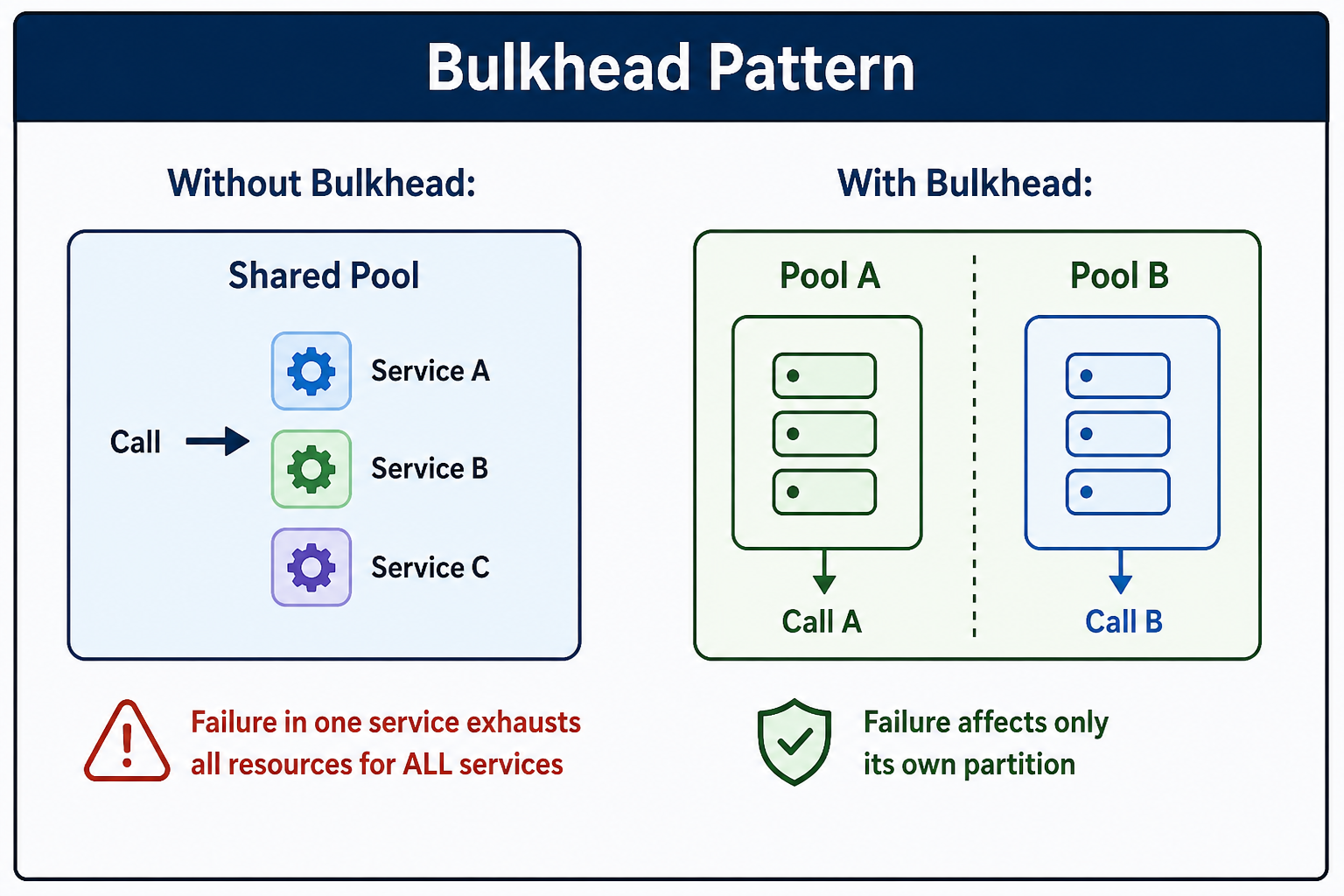
The bulkhead pattern is a resilience design pattern that isolates different parts of a system by limiting concurrent access to resources. Named after ship compartments, it ensures that failure in one service does not consume all application resources and cause a system-wide crash.
Bulkhead Pattern: Isolating Failures in Distributed Systems
The bulkhead pattern is a resilience design pattern that isolates different parts of a system by limiting concurrent access to resources. Named after the compartmentalized hulls of ships, the pattern ensures that if one part of the system fails, the failure does not spread and consume all available resources, preventing a complete system shutdown. In a ship, if one compartment floods, the bulkhead walls contain the water so the ship stays afloat. Similarly, in software, the bulkhead pattern contains failures to specific components.
In distributed systems, failures are inevitable. When one service slows down or fails, it can exhaust thread pools, connection pools, and memory, causing cascading failures across the entire application. The bulkhead pattern prevents this by partitioning resources. To understand bulkheads properly, it helps to be familiar with the circuit breaker pattern, retry pattern, and microservices architecture.
What Is the Bulkhead Pattern?
The bulkhead pattern partitions resources, such as thread pools, connection pools, or memory, into isolated groups. Each partition serves a specific set of operations or services. When one partition becomes saturated or fails, the other partitions remain available, allowing the system to degrade gracefully rather than failing completely.
- Resource Isolation: Each bulkhead has its own dedicated resource pool.
- Failure Containment: Problems in one bulkhead stay within that bulkhead.
- Graceful Degradation: System continues functioning, perhaps with reduced capacity for some operations.
- Controlled Concurrency: Limits how many requests can execute simultaneously for a given service.
- Backpressure Management: Rejects requests when a bulkhead is full instead of letting them queue indefinitely.
Why the Bulkhead Pattern Matters
Without bulkheads, a single slow or failing service can exhaust shared resources and bring down an entire system. Consider a shared thread pool that handles requests for multiple services. One service becomes slow due to a database issue. Its requests start taking longer, occupying more threads. The thread pool fills up with waiting requests. Now other healthy services cannot get threads and stop responding.
- Cascading Failure Prevention: Stops a single failure from propagating across services.
- Resource Protection: Prevents thread pools and connection pools from being exhausted.
- Predictable Capacity: Each service has guaranteed resources regardless of other services' health.
- Faster Failure Detection: When a bulkhead fills up, it fails fast rather than waiting for timeouts.
- Improved SLA Enforcement: Critical services can be allocated more resources than non-critical ones.
Types of Bulkheads
Thread Pool Bulkhead
A thread pool bulkhead allocates separate thread pools to different services or operations. Each service has its own set of threads. If one service's thread pool fills up, other services continue unaffected. This provides strong isolation but uses more system resources because each thread pool has overhead.
- Strong Isolation: Complete separation of execution contexts.
- Higher Overhead: Each thread pool consumes memory and creates context switching costs.
- Queue Management: Thread pools typically have queues for pending tasks.
Semaphore Bulkhead
A semaphore bulkhead limits concurrent calls without managing separate thread pools. It uses a semaphore, a simple counter, to track how many calls are in progress. When the limit is reached, new calls are rejected. All calls still run on the same shared thread pool but are prevented from exceeding the concurrency limit.
- Lightweight: No additional thread pool overhead.
- Weaker Isolation: Threads are still shared, but concurrency is limited.
- No Queue: Exceeding calls are rejected immediately, not queued.
- Lower Memory Footprint: Good for most I/O-bound applications.
Connection Pool Bulkhead
Database connection pools are a common form of bulkhead. Instead of a single shared connection pool for all services, each service gets its own pool. A database connection pool helps, but if one service exhausts the pool, all services using that pool are affected. Service-specific pools prevent this.
CPU and Memory Bulkhead
In containerized environments, you can implement bulkheads using CPU and memory limits. Kubernetes and Docker allow you to set resource limits per service or container. Even if one service leaks memory or consumes excessive CPU, it cannot affect other services on the same host.
| Bulkhead Type | Isolation Level | Overhead | Best For |
|---|---|---|---|
| Thread Pool | Strong | High | CPU-bound operations, strict isolation requirements |
| Semaphore | Moderate | Low | I/O-bound operations, most microservices |
| Connection Pool | Moderate | Low | Database access, external API clients |
| Container Resources | Strong | Low | Cloud-native and containerized applications |
Bulkhead Pattern in Practice
The bulkhead pattern is commonly implemented using semaphores or thread pools. A semaphore-based bulkhead sets a maximum number of concurrent calls allowed. When a call comes in, the bulkhead tries to acquire a permit. If a permit is available, the call executes. If not, the call is rejected immediately with a failure signal rather than waiting indefinitely.
Configuration Parameters
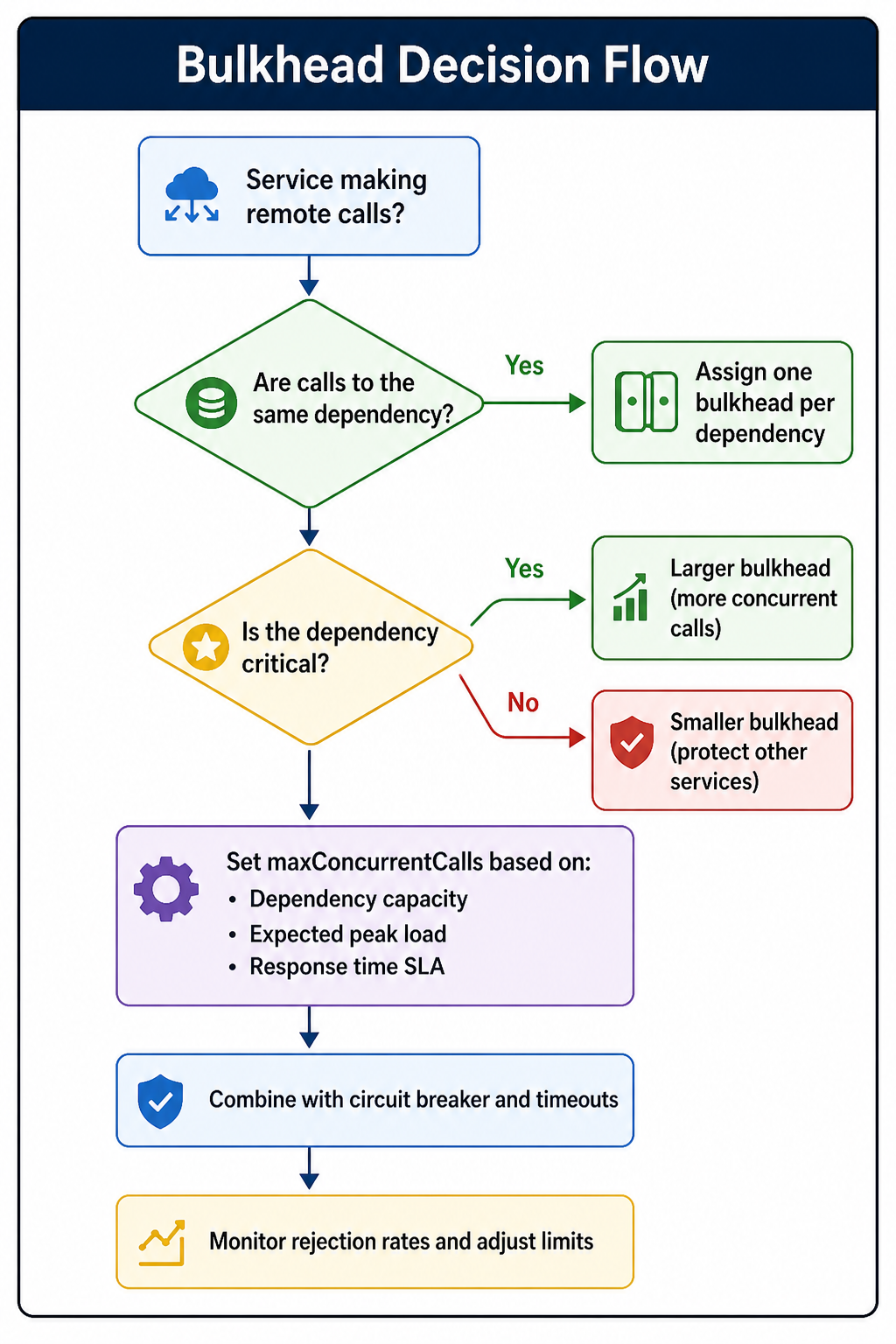
- maxConcurrentCalls: The maximum number of calls that can execute simultaneously. This should be set based on the service's capacity and expected load.
- maxWaitDuration: Maximum time a call waits for a permit before being rejected. For semaphore bulkheads, this is typically set to zero for immediate rejection, which is faster to fail.
- queueCapacity: For thread pool bulkheads, the size of the queue for pending tasks when all threads are busy.
- keepAliveDuration: For thread pool bulkheads, how long excess threads survive when idle.
Scenarios for Bulkhead Implementation
Multi-Tenant Systems
In systems serving multiple tenants or customers, you can allocate separate bulkheads per tenant. A sudden spike in traffic from one tenant does not degrade performance for others. Each tenant gets a guaranteed share of resources.
Critical vs Non-Critical Operations
Critical operations like checkout processing should have larger bulkheads than non-critical operations like analytics reporting. If analytics fails or slows down, checkout continues working because bulkheads isolate them.
External Dependencies
Each external service or API your application calls should have its own bulkhead. If the payment gateway slows down, it should not affect your ability to call the inventory service. Separate bulkheads for each dependency provide this isolation.
Slow Endpoints
Some endpoints naturally take longer than others. Without bulkheads, slow endpoints can exhaust shared resources. Giving slow endpoints their own bulkhead ensures they do not block faster endpoints.
Bulkhead vs Circuit Breaker
The bulkhead and circuit breaker patterns are often confused because both improve system resilience. However, they address different problems and work well together.
| Aspect | Bulkhead Pattern | Circuit Breaker Pattern |
|---|---|---|
| Problem Solved | Prevents resource exhaustion from concurrent calls | Prevents repeated calls to a failing service |
| Mechanism | Limits concurrency through permits or thread pools | Tracks failures and opens circuit to block calls |
| When It Triggers | When concurrency limit is reached | When failure rate exceeds threshold |
| Recovery | Callers retry later when concurrency reduces | Circuit closes after timeout when failures stop |
| Typical Configuration | maxConcurrentCalls, queue size | failure rate, timeout, threshold |
Use both patterns together. The bulkhead pattern prevents resource exhaustion. The circuit breaker pattern prevents wasting calls on a failing service. When a circuit breaker opens, calls stop entering the bulkhead, allowing the bulkhead's pending calls to complete and free up permits.
Bulkhead Anti-Patterns
- Setting Limits Too High: If your bulkhead limits are higher than what your system can handle, they provide no protection. Limits should be based on actual resource capacity.
- Setting Limits Too Low: Limits set too low reject legitimate traffic and cause unnecessary failures. Monitor actual concurrency and tune accordingly.
- One Bulkhead for Everything: A single bulkhead for all services defeats the purpose. The goal is isolation, so different services and dependencies need different bulkheads.
- Ignoring Timeouts: Bulkheads prevent new calls from entering, but existing calls that hang still occupy permits. Always combine bulkheads with timeouts for complete protection.
- No Monitoring: Without metrics, you cannot know if your bulkheads are too small, too large, or being hit frequently. Monitor bulkhead usage and rejection rates.
- Async Without Bulkhead: Asynchronous code still needs bulkheads. Even when not blocking threads, resource limits like connection pools can be exhausted.
Implementing Bulkheads in Different Environments
In Microservices
In a microservices architecture, each service should have its own bulkheads for each downstream dependency. This ensures that a problem with one dependency, such as the payment service, does not affect calls to another dependency, such as the inventory service.
In Monolithic Applications
Monolithic applications can benefit from bulkheads at the module level. Different modules or features can have separate thread pools or semaphores. This prevents one slow feature from making the entire application unresponsive.
In Containerized Environments
Kubernetes and Docker provide built-in bulkhead capabilities through resource limits. You can set CPU and memory limits per container. However, these operate at the container level. For finer-grained isolation within an application, still use thread pool or semaphore bulkheads.
With Resilience Libraries
Popular resilience libraries like Resilience4j, Hystrix, and Polly provide built-in bulkhead implementations. These libraries handle permit acquisition, timing out waiting requests, and exposing metrics. They are covered in our Resilience4j guide.
Monitoring Bulkheads
Effective bulkhead implementation requires monitoring. Without visibility, you cannot know if your bulkheads are correctly sized or if they are rejecting requests.
- Available Permits: How many concurrent calls are currently allowed. Low permits indicate high load.
- Queue Size: For thread pool bulkheads, how many calls are waiting. Growing queues indicate capacity problems.
- Rejection Count: How many calls were rejected because the bulkhead was full. Spikes indicate insufficient capacity.
- Call Duration: How long calls take. Slow calls hold permits longer, reducing available concurrency.
- Thread Pool Statistics: Active threads, idle threads, and queue depth for thread pool bulkheads.
Bulkhead Best Practices
- Start with Semaphores: For most I/O-bound applications, semaphore bulkheads provide sufficient isolation with lower overhead than thread pools.
- Size Based on Real Metrics: Observe actual concurrency patterns in production and size bulkheads accordingly. Percentile-based sizing is more robust than averages.
- Combine with Timeouts: Always use timeouts with bulkheads. A slow call can hold a permit indefinitely, effectively reducing bulkhead capacity.
- Use Different Bulkheads for Different Dependencies: Each downstream service should have its own bulkhead. A slow database should not affect API calls.
- Set Rejection Timeouts to Zero: For semaphore bulkheads, failing fast is usually better than letting callers wait.
- Monitor and Tune Continuously: Bulkhead sizing is not one-time. As load patterns change, revisit your configuration.
- Test Bulkhead Overflow: Use chaos testing to verify that exceeding a bulkhead limit fails gracefully.
- Document Bulkhead Configuration: Record which services have which bulkheads and why limits were chosen.
Frequently Asked Questions
- What is the difference between bulkhead and circuit breaker?
Bulkhead limits concurrent calls to prevent resource exhaustion. Circuit breaker stops calls to a failing service to prevent wasted requests. They solve different problems and work together. A circuit breaker opens when failures occur; a bulkhead enforces concurrency limits regardless of success or failure. - When should I use thread pool bulkhead vs semaphore bulkhead?
Use semaphore bulkhead for most I/O-bound operations. It is lightweight and sufficient. Use thread pool bulkhead when you need strong thread isolation, such as when different services have different thread affinity requirements or when you want to isolate slow operations into separate thread pools to prevent them from blocking faster operations. - How do I choose the maxConcurrentCalls value?
Base it on your service's observed concurrency patterns. A starting point is typical concurrent requests plus a safety margin. Monitor rejection rates and adjust up if too many calls are rejected, or down if resources are underutilized. Also consider the downstream service's capacity and connection limits. - Can bulkhead prevent all cascading failures?
No. Bulkhead prevents resource exhaustion failures but does not protect against data corruption, business logic errors, or failures that depend on shared state beyond concurrency. Use bulkhead as part of a comprehensive resilience strategy that includes circuit breakers, retries, timeouts, and fallbacks. - Do I need bulkheads if I use async non-blocking code?
Yes. Asynchronous code still needs bulkheads. While it may not exhaust thread pools, it can exhaust other resources like connection pools, memory, and event loop capacity. Semaphore bulkheads are particularly well-suited for reactive and async applications. - What should I learn next after the bulkhead pattern?
After mastering bulkheads, explore the circuit breaker pattern for handling failing services, the retry pattern for transient failures, Resilience4j library for implementation, microservices architecture, and timeout patterns for bounding operation duration.