
Object-Oriented Programming: Classes, Objects and OOP Principles
Object-Oriented Programming (OOP) is a programming paradigm that organizes code into objects containing data and methods. The four main principles are encapsulation, inheritance, polymorphism, and abstraction, which help create modular, reusable, and maintainable software.
Object-Oriented Programming: Classes, Objects and OOP Principles
Object-Oriented Programming (OOP) is a programming paradigm that organizes code around objects rather than functions and logic. An object contains data in the form of fields, often called attributes or properties, and code in the form of methods or procedures. OOP aims to create modular, reusable, and maintainable software by modeling real-world entities as objects that have state and behavior.
OOP is one of the most widely used programming paradigms in modern software development. To understand OOP properly, it helps to be familiar with procedural programming concepts and basic programming constructs like variables, functions, and data structures.
What Is Object-Oriented Programming?
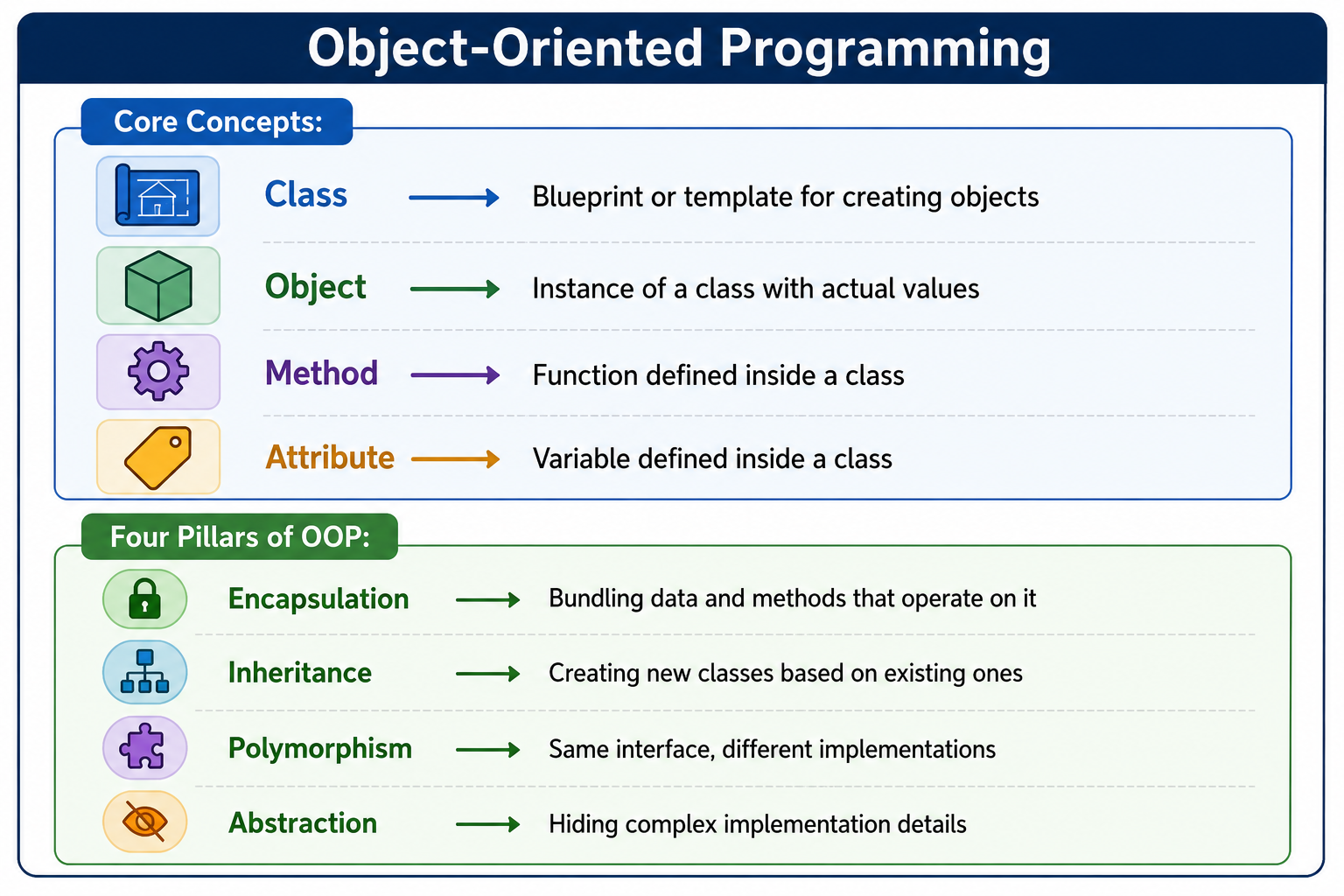
Object-Oriented Programming is a programming model that organizes software design around objects rather than functions and logic. Objects represent real-world entities or concepts. Each object contains data and the methods that operate on that data. This bundling of data and behavior is the foundation of OOP.
- Class: A blueprint or template for creating objects. It defines the attributes and methods that objects of that class will have.
- Object: An instance of a class. Each object has its own state, which is the values of its attributes, and can perform actions defined by its methods.
- Method: A function defined inside a class that describes the behaviors or actions an object can perform.
- Attribute: A variable defined inside a class that holds data specific to each object.
- Constructor: A special method that initializes new objects when they are created from a class.
The Four Pillars of Object-Oriented Programming
Encapsulation
Encapsulation is the bundling of data and the methods that operate on that data within a single unit, the class. It also involves restricting direct access to an object's internal state, exposing only what is necessary through public methods. This protects data integrity and prevents unintended interference.
- Data Hiding: Internal object state is hidden from outside code.
- Public Interface: Controlled access through public methods, often called getters and setters.
- Access Modifiers: Keywords like public, private, and protected control visibility.
- Benefits: Prevents accidental modification, reduces coupling, and allows internal implementation changes without affecting external code.
Inheritance
Inheritance allows a class to derive properties and methods from another class. The class that inherits is called the subclass or child class. The class being inherited from is called the superclass or parent class. Inheritance promotes code reuse and establishes a natural hierarchy between classes.
- Code Reuse: Subclasses automatically have all non-private attributes and methods of the parent.
- Method Overriding: Subclasses can provide specific implementations of methods defined in the parent.
- Single Inheritance: Most languages allow a class to inherit from only one parent, though some support multiple inheritance.
- Super Keyword: Used to access parent class methods and constructors from a subclass.
Polymorphism
Polymorphism means having many forms. In OOP, polymorphism allows objects of different classes to be treated as objects of a common superclass. The same method call can behave differently depending on the actual object type. This enables flexible and extensible code.
- Compile-Time Polymorphism: Method overloading, where multiple methods share the same name but different parameters.
- Runtime Polymorphism: Method overriding, where a subclass provides a specific implementation of a parent method.
- Interface Polymorphism: Different classes implementing the same interface can be used interchangeably.
- Benefits: Code that works on the superclass level automatically works with any subclass.
Abstraction
Abstraction is the concept of hiding complex implementation details and showing only essential features. It simplifies interaction with complex systems by exposing a clean, easy-to-use interface while hiding internal complexity. Abstraction is closely related to encapsulation but focuses on the interface rather than data hiding.
- Abstract Classes: Cannot be instantiated and may contain abstract methods without implementation.
- Interfaces: Define a contract of methods that implementing classes must provide, with no implementation details.
- Implementation Hiding: Users of a class only need to know what it does, not how it does it.
- Benefits: Reduces complexity, improves maintainability, and allows implementation changes without affecting users.
| Pillar | Definition | Main Benefit |
|---|---|---|
| Encapsulation | Bundling data and methods, restricting direct access | Data protection and reduced coupling |
| Inheritance | Creating new classes based on existing ones | Code reuse and hierarchical organization |
| Polymorphism | Same interface, different implementations | Flexibility and extensibility |
| Abstraction | Hiding implementation details, exposing essential features | Simplified interfaces and reduced complexity |
Classes and Objects in Depth
Classes and objects are the fundamental building blocks of object-oriented programming. A class defines the structure and behavior. An object is a concrete instance of that class with actual values.
Class Components
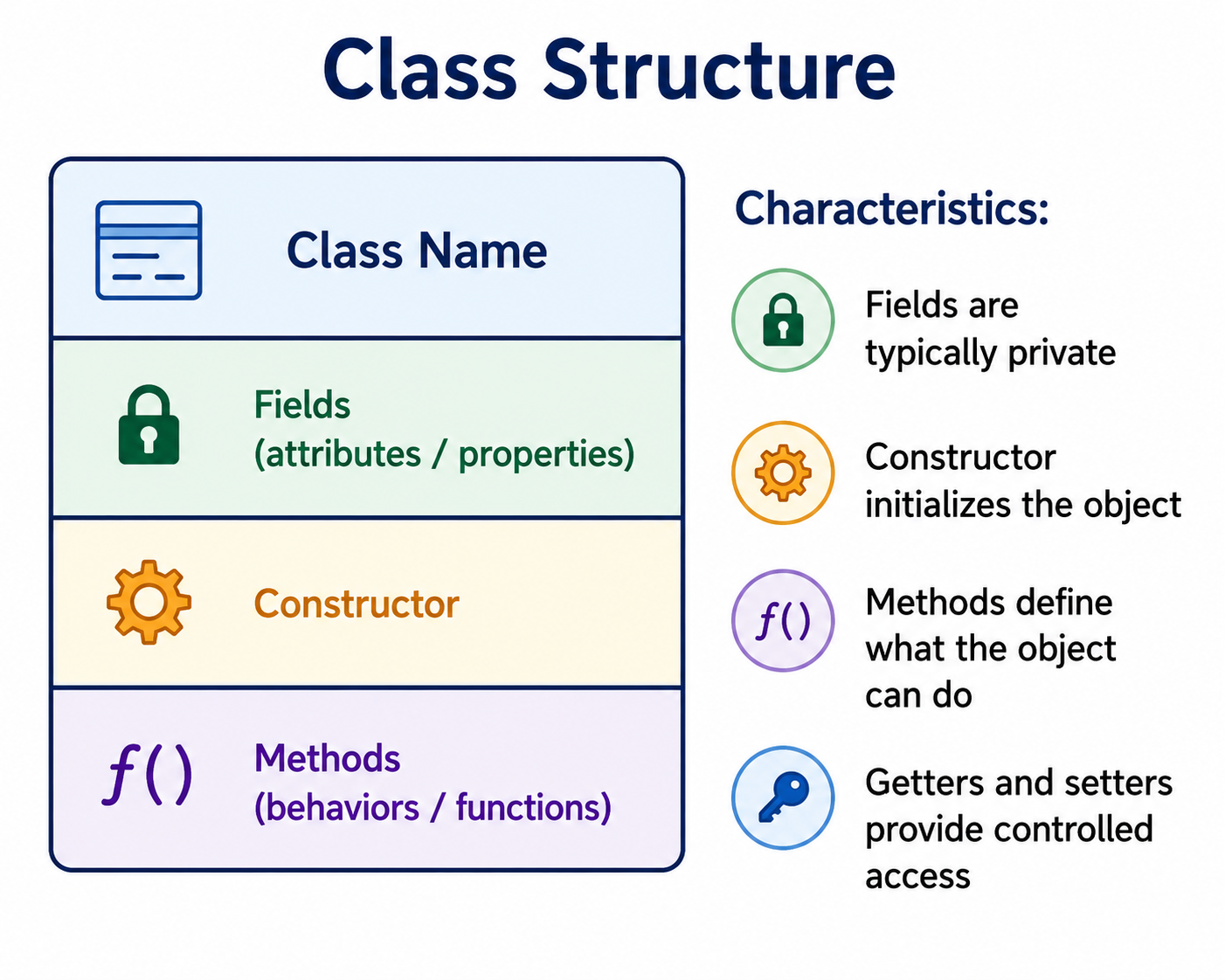
- Fields or Properties: Variables that hold the state of an object. Each object has its own copy of the fields defined in its class.
- Methods: Functions that define what an object can do. Methods can access and modify the object's fields.
- Constructors: Special methods called when an object is created. They initialize the object's fields to appropriate starting values.
- Static Members: Fields and methods that belong to the class itself rather than any specific instance. Static members are shared across all objects of the class.
Object Lifecycle
- Declaration: Declaring a variable of a class type.
- Instantiation: Creating an object using the new keyword followed by a constructor.
- Initialization: The constructor runs to set initial state.
- Usage: Calling methods and accessing fields of the object.
- Destruction: Object is cleaned up by garbage collection or explicit destruction.
Relationships Between Classes
Inheritance, Is-A Relationship
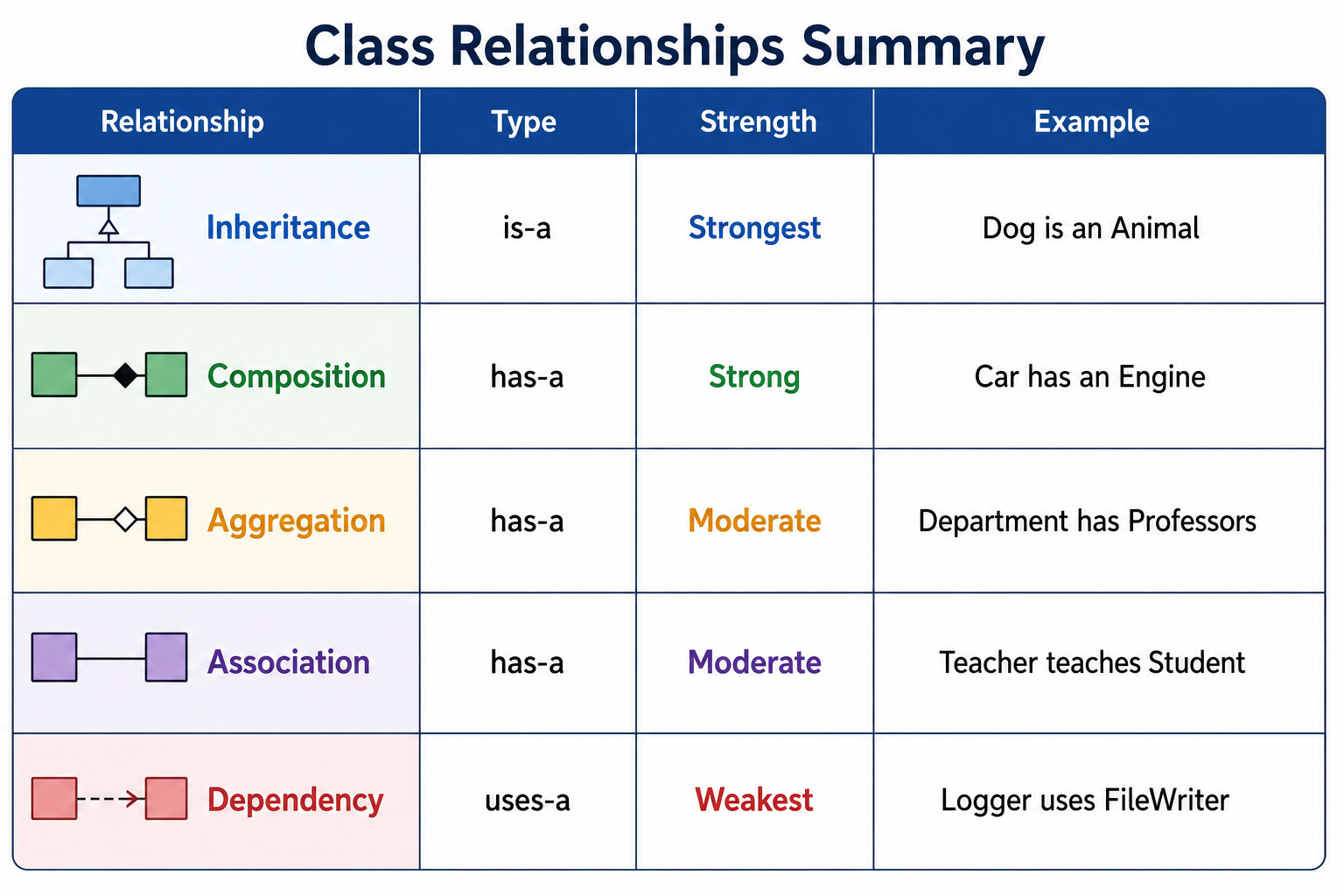
Inheritance represents an is-a relationship. A dog is a mammal, a teaching assistant is a student. When class B inherits from class A, every B is also an A. This is the strongest form of coupling between classes.
Association, Has-A Relationship
Association represents a has-a relationship. A car has an engine, a library has books. Association is weaker than inheritance and can be one-way or two-way. Composition and aggregation are specific forms of association.
Composition, Strong Has-A
Composition is a strong form of association where the child object cannot exist independently of the parent. When the parent is destroyed, the child is destroyed too. A house has rooms. If the house is demolished, the rooms are destroyed with it.
Aggregation, Weak Has-A
Aggregation is a weaker form of association where the child object can exist independently of the parent. A department has professors. If the department is closed, the professors still exist and can work in another department.
Dependency, Uses-A Relationship
Dependency is the weakest relationship. Class A depends on class B if A uses B in some way, such as receiving B as a parameter or returning B. Changes to B might affect A, but B has no knowledge of A.
Object-Oriented Design Principles
SOLID Principles
SOLID is an acronym for five design principles that make object-oriented code more maintainable and scalable.
- Single Responsibility Principle: A class should have only one reason to change, meaning it should have only one job or responsibility.
- Open-Closed Principle: Classes should be open for extension but closed for modification. You should be able to add new functionality without changing existing code.
- Liskov Substitution Principle: Objects of a superclass should be replaceable with objects of a subclass without affecting program correctness.
- Interface Segregation Principle: No client should be forced to depend on methods it does not use. Many specific interfaces are better than one general interface.
- Dependency Inversion Principle: High-level modules should not depend on low-level modules. Both should depend on abstractions rather than concretions.
Other Important Principles
- Composition Over Inheritance: Prefer composing objects using has-a relationships rather than inheriting behavior through is-a relationships when possible.
- Encapsulate What Changes: Identify aspects that vary and separate them from aspects that stay the same.
- Program to an Interface, Not an Implementation: Rely on abstract interfaces rather than concrete implementations to reduce coupling.
- Law of Demeter: Only talk to your immediate friends. A method should only call methods on itself, its parameters, objects it creates, or its direct component objects.
Object-Oriented Programming Languages
| Language | OOP Features | Common Use Cases |
|---|---|---|
| Java | Full OOP with classes, interfaces, single inheritance | Enterprise applications, Android, backend systems |
| Python | Supports OOP with multiple inheritance, dynamic typing | Web development, data science, automation, AI |
| C | Full OOP with multiple inheritance, operator overloading | Game development, system software, performance-critical apps |
| C | Full OOP with interfaces, delegates, properties | Windows applications, game development, enterprise software |
| JavaScript | Prototype-based OOP, classes added in ES6 | Web frontend, Node.js backend, full-stack development |
| Ruby | Pure OOP where everything is an object | Web development, especially Ruby on Rails |
| PHP | Supports OOP with classes, interfaces, traits | Web development, content management systems |
Common OOP Anti-Patterns
- God Object: A class that knows too much or does too much. It violates single responsibility principle and becomes hard to maintain and test.
- Anemic Domain Model: A class with many fields but almost no behavior. Business logic is placed in separate service classes instead of where the data lives.
- Inheritance Abuse: Using inheritance when composition would be more appropriate. Creating deep inheritance hierarchies that are fragile and hard to understand.
- Feature Envy: A method that seems more interested in another class's data than its own. This indicates misplaced responsibility.
- Circular Dependency: Two or more classes depend on each other directly or indirectly. This creates tight coupling and makes changes difficult.
- Leaky Abstraction: An abstraction that exposes implementation details that should be hidden. This violates encapsulation principles.
Object-Oriented vs Procedural Programming
| Aspect | Object-Oriented Programming | Procedural Programming |
|---|---|---|
| Organization | Organized around objects and classes | Organized around functions and procedures |
| Data and Behavior | Bundled together within objects | Data and functions are separate |
| Code Reuse | Inheritance and composition | Function libraries and includes |
| Modularity | High encapsulation and data hiding | Limited encapsulation, global data common |
| Complexity Management | Better for large, complex systems | Better for small, straightforward programs |
Benefits of Object-Oriented Programming
- Modularity: Objects are independent and can be developed, tested, and maintained separately.
- Code Reusability: Inheritance and composition allow reusing existing code rather than rewriting it.
- Maintainability: Encapsulation and clear interfaces make it easier to change implementations without breaking other code.
- Scalability: OOP principles help manage complexity as systems grow in size and features.
- Real-World Modeling: Objects naturally represent real-world entities, making design more intuitive.
- Team Development: Clear boundaries between classes allow multiple developers to work on different parts of a system simultaneously.
Drawbacks of Object-Oriented Programming
- Complexity: OOP can be overkill for simple programs that procedural programming would handle more directly.
- Performance Overhead: Runtime polymorphism and dynamic dispatch have some performance cost compared to procedural code.
- Learning Curve: Understanding inheritance, polymorphism, and design patterns takes time and practice.
- Deep Hierarchies: Overuse of inheritance can create fragile, hard-to-understand class hierarchies.
- Object Relational Impedance Mismatch: Storing objects in relational databases requires mapping and can be complex.
Object-Oriented Best Practices
- Keep Classes Focused: Each class should have a single, clear responsibility. If a class description contains the word and, it probably has too many responsibilities.
- Favor Composition Over Inheritance: Inheritance creates tight coupling. Use composition to assemble behaviors from smaller, reusable components.
- Encapsulate Implementation Details: Keep fields private and provide controlled access through methods. This allows changing implementation without affecting users.
- Program to Interfaces: Depend on abstract interfaces rather than concrete classes. This makes code more flexible and testable.
- Write Readable Code: Class and method names should clearly communicate their purpose. Code is read more often than it is written.
- Test Your Classes: Unit test each class in isolation. Good encapsulation makes classes easier to test.
- Document Public APIs: Document what each public method does, what parameters it expects, and what it returns.
- Avoid Deep Inheritance Trees: Shallow inheritance trees are easier to understand and maintain. Prefer interface implementation over deep class hierarchies.
Frequently Asked Questions
- What is the difference between a class and an object?
A class is a blueprint or template that defines the structure and behavior. An object is a concrete instance of a class created in memory. You can think of a class as a cookie cutter and objects as the cookies made from that cutter. - What is the difference between abstraction and encapsulation?
Abstraction focuses on what an object does, hiding how it does it. Encapsulation focuses on protecting data by controlling access. Abstraction is about the interface. Encapsulation is about implementation hiding. They are related but distinct concepts. - When should I use inheritance vs composition?
Use inheritance for strict is-a relationships where subclass genuinely is a specialized version of the parent. Use composition for has-a relationships where you want to assemble behaviors from independent parts. Composition is more flexible and preferred in most cases because it creates looser coupling. - What is method overloading vs method overriding?
Overloading means multiple methods in the same class share the same name but have different parameters. Overriding means a subclass provides a specific implementation of a method defined in its parent class. Overloading is compile-time polymorphism. Overriding is runtime polymorphism. - Is object-oriented programming always the best choice?
No. OOP is excellent for large, complex systems but can be overkill for small scripts or simple programs. Other paradigms like functional programming or procedural programming may be more appropriate depending on the problem domain. Many modern systems use a mix of paradigms. - What should I learn next after object-oriented programming?
After mastering OOP, explore design patterns for common OOP solutions, SOLID principles in depth, functional programming for an alternative paradigm, clean architecture for system design, and refactoring for improving existing OOP code.