
Infrastructure as Code: Managing Infrastructure Through Configuration
Infrastructure as Code (IaC) is the practice of managing and provisioning computing infrastructure through machine-readable configuration files rather than physical hardware configuration or interactive configuration tools. It enables version control, automated deployment, and consistent environment reproducibility.
Infrastructure as Code: Managing Infrastructure Through Configuration
Infrastructure as Code (IaC) is the practice of managing and provisioning computing infrastructure through machine-readable configuration files rather than physical hardware configuration or interactive configuration tools. Instead of manually clicking through cloud consoles or running commands on servers, you define your infrastructure, including servers, networks, load balancers, and databases, in configuration files that can be versioned, reviewed, and reused.
IaC brings software development practices to infrastructure management. To understand IaC properly, it helps to be familiar with cloud deployment models, containerization, and CI/CD pipelines.
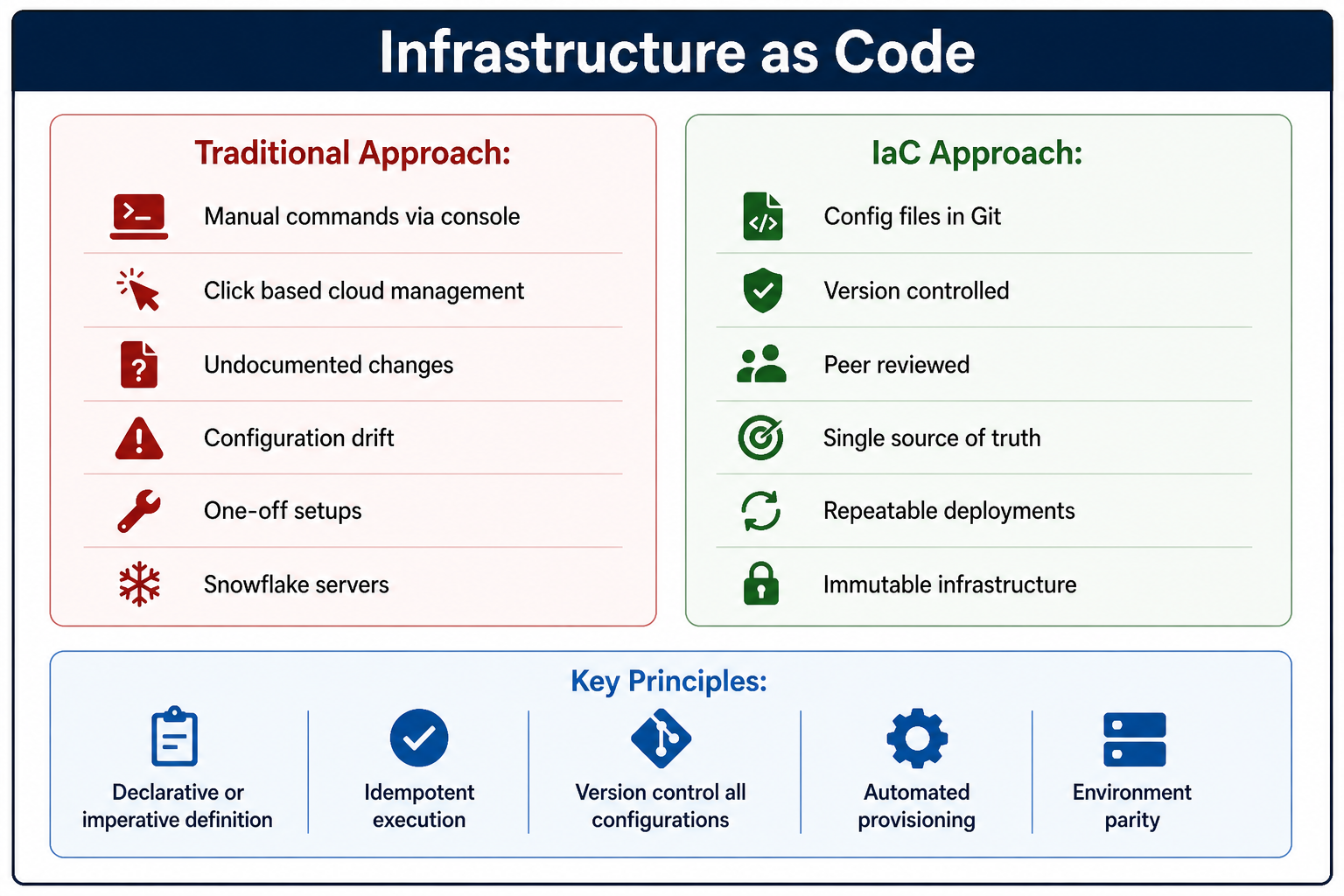
What Is Infrastructure as Code?
Infrastructure as Code is the practice of treating infrastructure resources, such as virtual machines, networks, load balancers, and databases, as software artifacts. You define what your infrastructure should look like in code, then run that code to create, update, or delete resources in your cloud or on-premises environment.
- Declarative Approach: You declare the desired state of your infrastructure, and the tool figures out how to achieve it.
- Imperative Approach: You specify the exact commands or steps to execute to reach the desired state.
- Idempotency: Running the same configuration multiple times produces the same result without duplicate resources or errors.
- Version Controlled: All infrastructure definitions are stored in version control systems like Git.
- Automated Execution: Infrastructure changes are applied through automation rather than manual intervention.
Why Infrastructure as Code Matters
Traditional infrastructure management relies on manual processes, which are error-prone, difficult to reproduce, and impossible to audit effectively. IaC addresses these problems by applying established software engineering practices to infrastructure.
- Consistency and Repeatability: The same configuration produces identical environments, eliminating configuration drift and environment inconsistencies.
- Version Control and Auditability: Every infrastructure change is tracked in version control with who made it, when, and why.
- Faster Deployment: Provisioning entire environments takes minutes instead of days or weeks.
- Reduced Human Error: Automated execution eliminates mistakes from manual commands and click-ops.
- Disaster Recovery: Rebuilding entire infrastructure from code is reliable and fast after a disaster.
- Cost Efficiency: Short-lived environments for testing and development become practical because provisioning is automated.
- Documentation as Code: The configuration files document exactly what infrastructure exists and how it is configured.
Declarative vs Imperative IaC
| Aspect | Declarative IaC | Imperative IaC |
|---|---|---|
| Focus | What the end state should be | What steps to execute |
| Idempotency | Built-in | Must be implemented manually |
| Learning Curve | Easier to learn and understand | Requires programming knowledge |
| Flexibility | Limited to what the tool supports | Full programming language power |
| Examples | Terraform, CloudFormation, ARM templates | Ansible (playbooks), Chef, Pulumi (imperative mode) |
Common IaC Tools
Terraform
Terraform is a declarative IaC tool by HashiCorp that supports multiple cloud providers through a single workflow. It uses a declarative configuration language called HashiCorp Configuration Language or JSON. Terraform builds a dependency graph of resources and creates or updates them in the correct order. It maintains a state file that tracks real-world infrastructure, which is essential for understanding and updating existing resources.
AWS CloudFormation
CloudFormation is Amazon's native declarative IaC service for AWS. It uses YAML or JSON templates to define AWS resources. CloudFormation manages the full lifecycle of resources and provides deep integration with other AWS services like IAM for permissions and CloudTrail for auditing.
Azure Resource Manager and ARM Templates
ARM Templates are Microsoft's declarative IaC solution for Azure. They use JSON to define Azure resources and provide idempotent deployments. ARM Templates can be parameterized for different environments.
Google Cloud Deployment Manager
Deployment Manager is Google's declarative IaC service for GCP. It uses YAML or Python configuration files and supports Jinja or Python templates for reusable infrastructure components.
Ansible
Ansible is a configuration management and automation tool that can also be used for IaC. It is primarily imperative but supports declarative patterns for many resources. Ansible agentless architecture uses SSH for Linux and WinRM for Windows.
Pulumi
Pulumi enables writing infrastructure code in general-purpose programming languages like TypeScript, Python, Go, and C. It provides imperative flexibility while maintaining declarative semantics. Pulumi supports multiple cloud providers through a single workflow.
Chef and Puppet
Chef and Puppet are configuration management tools that can also handle infrastructure provisioning. Chef uses Ruby-based DSL and Puppet uses its own declarative language. Both are more focused on configuring and maintaining existing servers than provisioning new cloud resources.
| Tool | Approach | Primary Use | State Management |
|---|---|---|---|
| Terraform | Declarative | Multi-cloud provisioning | State file or remote backend |
| CloudFormation | Declarative | AWS native provisioning | AWS managed state |
| Pulumi | Imperative or declarative | Multi-cloud with programming languages | Managed or local state |
| Ansible | Imperative or declarative | Configuration management and provisioning | Agentless, no state file |
IaC Best Practices
Version Control Everything
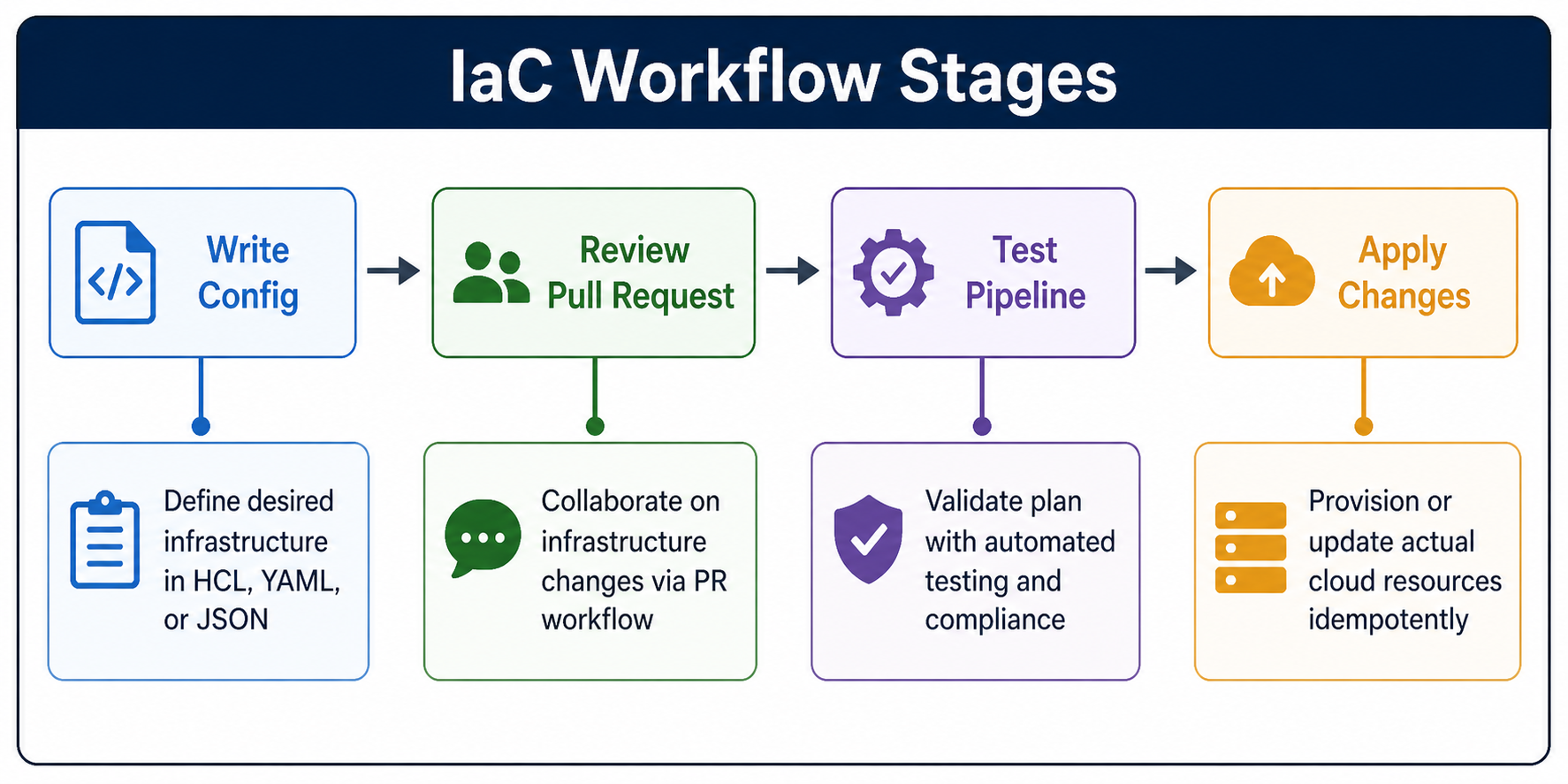
All infrastructure code belongs in version control. This includes configuration files, modules, and any scripts used to provision infrastructure. Version control provides collaboration, audit trails, and rollback capabilities. Use feature branches and pull requests for infrastructure changes just like application code.
Use Modules for Reusability
Module-based design organizes infrastructure into reusable components. Most IaC tools support modules that encapsulate resources and configuration. Common modules include networking, compute instances, databases, and load balancers. Modules reduce duplication, improve consistency, and make infrastructure easier to maintain.
Separate Configuration Environments
Different environments for development, staging, and production should be defined separately but use the same underlying modules. Environment-specific configuration includes resource sizes, network settings, and feature flags. This ensures environments remain consistent while allowing environment-specific tuning.
Manage Secrets Securely
Never store passwords, API keys, or certificates in infrastructure code. Use secret management tools like HashiCorp Vault, AWS Secrets Manager, Azure Key Vault, or GCP Secret Manager. Most IaC tools integrate with these services to retrieve secrets at runtime without exposing them in configuration files.
Test Infrastructure Code
Infrastructure code should be tested like application code. Unit tests validate configuration logic. Integration tests verify resources are created correctly. End-to-end tests confirm the infrastructure supports application requirements. Tools like Terratest, Terratest, and kitchen-terraform enable automated infrastructure testing.
Implement CI/CD for Infrastructure
Infrastructure changes should go through CI/CD pipelines. The pipeline validates configuration syntax, runs tests, performs plan or preview steps, and applies changes after approval. This ensures consistent, auditable deployments. CI/CD pipelines are essential for production infrastructure changes.
Use Remote State Backends
Local state files are risky for team environments. Use remote backends like Terraform Cloud, AWS S3 with DynamoDB locking, Azure Storage, or GCS that support state locking and team access. Remote state prevents conflicts and provides a single source of truth.
Apply the Principle of Least Privilege
The credentials and service accounts used to run IaC should have only the permissions needed for the resources they manage. Overly permissive credentials increase security risk if compromised. Use granular IAM roles that align with specific infrastructure modules.
Common IaC Anti-Patterns
- Hardcoded Values: Embedding environment-specific values like resource names, IP addresses, or sizes directly in configuration prevents reuse and environment parity.
- Unversioned Configuration: Infrastructure defined outside version control cannot be audited, rolled back, or shared effectively.
- Manual Changes to Provisioned Resources: Changing infrastructure directly breaks the IaC model. Always change code and apply it rather than modifying resources by hand.
- Monolithic Configuration: A single massive configuration file or repository is difficult to understand and modify. Split infrastructure into logical modules.
- No Environment Separation: Using the same configuration for development and production leads to testing with production or accidental production changes.
- Ignored Drift Detection: Without monitoring for drift, manual changes can go undetected, making infrastructure unreliable and audits impossible.
- Secrets in Configuration: Storing secrets in configuration files exposes them in version history and to anyone with repository access.
IaC and Immutable Infrastructure
Immutable infrastructure is the practice of never modifying a server after deployment. Instead of updating a server in place, you replace it with a new version. IaC naturally supports this pattern because you define the desired state, and the tool creates new resources to match that state rather than modifying existing ones when possible.
Immutable infrastructure offers several advantages. Updates are predictable and reversible because you deploy entirely new resources. Configuration drift is eliminated because servers are not modified after creation. Rollbacks are instantaneous since you simply revert to the previous infrastructure version. Security is improved because ephemeral servers reduce the window for persistent compromise.
Most IaC tools support immutable patterns, especially for compute resources. But some resources like databases may be harder to treat immutably due to data persistence requirements.
IaC and Configuration Management
Infrastructure as Code and configuration management are related but distinct practices. IaC provisions the infrastructure itself, such as virtual machines, networks, and load balancers. Configuration management installs and configures software on existing servers, such as installing web servers, application code, and system packages.
The two approaches complement each other. Many organizations use both: IaC to provision cloud resources and configuration management to configure those resources. Alternatively, some modern approaches use containerization to eliminate configuration management by packaging application dependencies into immutable container images.
State Management in IaC
State management is one of the most challenging aspects of declarative IaC tools. The tool maintains a state file that knows what resources it created and their current attributes. When you run an update, the tool compares the desired configuration against the state and real infrastructure to determine what changes are needed.
State management best practices include storing state in remote backends, enabling state locking to prevent concurrent modifications, isolating state by environment with separate state files or workspaces, and backing up state for disaster recovery.
Drift Detection and Remediation
Infrastructure drift occurs when actual infrastructure diverges from what is defined in configuration. This happens when someone makes manual changes, when an external process modifies resources, or when updates fail partially. Drift detection identifies discrepancies.
Most IaC tools provide drift detection. The tool compares real infrastructure against the desired configuration and reports differences. Some tools can automatically remediate drift by reapplying configuration. The best practice is to treat drift as an incident that should be investigated and corrected.
IaC Governance and Compliance
Infrastructure as Code provides opportunities for governance and compliance automation. Since infrastructure is code, you can enforce policies through static analysis, automated reviews, and policy-as-code tools.
- Policy as Code: Tools like Open Policy Agent, Sentinel, and Checkov evaluate IaC configurations against security and compliance rules before deployment.
- Cost Estimation: IaC tools can estimate the cost of proposed infrastructure changes before resources are created.
- Compliance Automation: Security controls like encryption, network isolation, and logging can be embedded directly into infrastructure modules.
- Audit Trails: Version control history and CI/CD logs provide complete audit trails for all infrastructure changes.
IaC for Disaster Recovery
One of the strongest benefits of IaC is disaster recovery. If your production infrastructure is lost due to a region failure, human error, or malicious attack, you can redeploy it from code.
Effective IaC-based disaster recovery requires storing infrastructure code in a separate location from provisioned resources, backing up state files or understanding how to recreate state, practicing recovery drills, and ensuring that critical data, such as databases, has separate backup strategies since IaC alone cannot recover data.
Frequently Asked Questions
- What is the difference between Infrastructure as Code and configuration management?
Infrastructure as Code provisions infrastructure resources like virtual machines, networks, and load balancers. Configuration management installs and configures software on existing servers. They are complementary, and many organizations use both, though containerization has reduced the need for configuration management in some scenarios. - Should I use Terraform, AWS CloudFormation, or Pulumi?
This depends on your requirements. Terraform is best for multi-cloud and when you want a single workflow across providers. CloudFormation is best for AWS-only environments and when you want deep AWS integration. Pulumi is best when you prefer writing infrastructure in general-purpose programming languages like TypeScript or Python. - What is the IaC state file and why does it matter?
The state file tracks what resources the IaC tool has created and their current attributes. It is essential for the tool to know which resources to update or delete. State files should be stored remotely with locking enabled for team use and should be backed up. - Can I use IaC for on-premises infrastructure?
Yes. Terraform and other IaC tools support many on-premises providers, including VMware vSphere, OpenStack, and bare metal provisioning with tools like MAAS. However, on-premises infrastructure may have less complete API coverage than public cloud providers. - How do I handle secrets in IaC?
Never store secrets in IaC configuration files. Use secret management tools like HashiCorp Vault, AWS Secrets Manager, or Azure Key Vault. Most IaC tools can retrieve secrets at runtime from these services. Use CI/CD pipeline secrets for variables needed during deployment. - What should I learn next after Infrastructure as Code?
After mastering IaC, explore CI/CD pipelines for automating infrastructure deployments, containerization for packaging applications, cloud deployment strategies, immutable infrastructure principles, and policy as code for governance automation.