
Database Normalization: What It Is and Why It Matters
Database normalization is the process of organizing data into structured tables to reduce redundancy and improve data integrity. It involves dividing large tables into smaller ones and defining relationships using normal forms such as 1NF, 2NF, and 3NF.
Database Normalization: Designing Efficient Data Structures
Database normalization is the process of organizing data in a database to reduce redundancy, improve data integrity, and simplify maintenance. It involves structuring tables and their relationships according to a set of rules called normal forms. A properly normalized database ensures that each piece of data is stored in exactly one place, eliminating duplication and the inconsistencies that come with it.
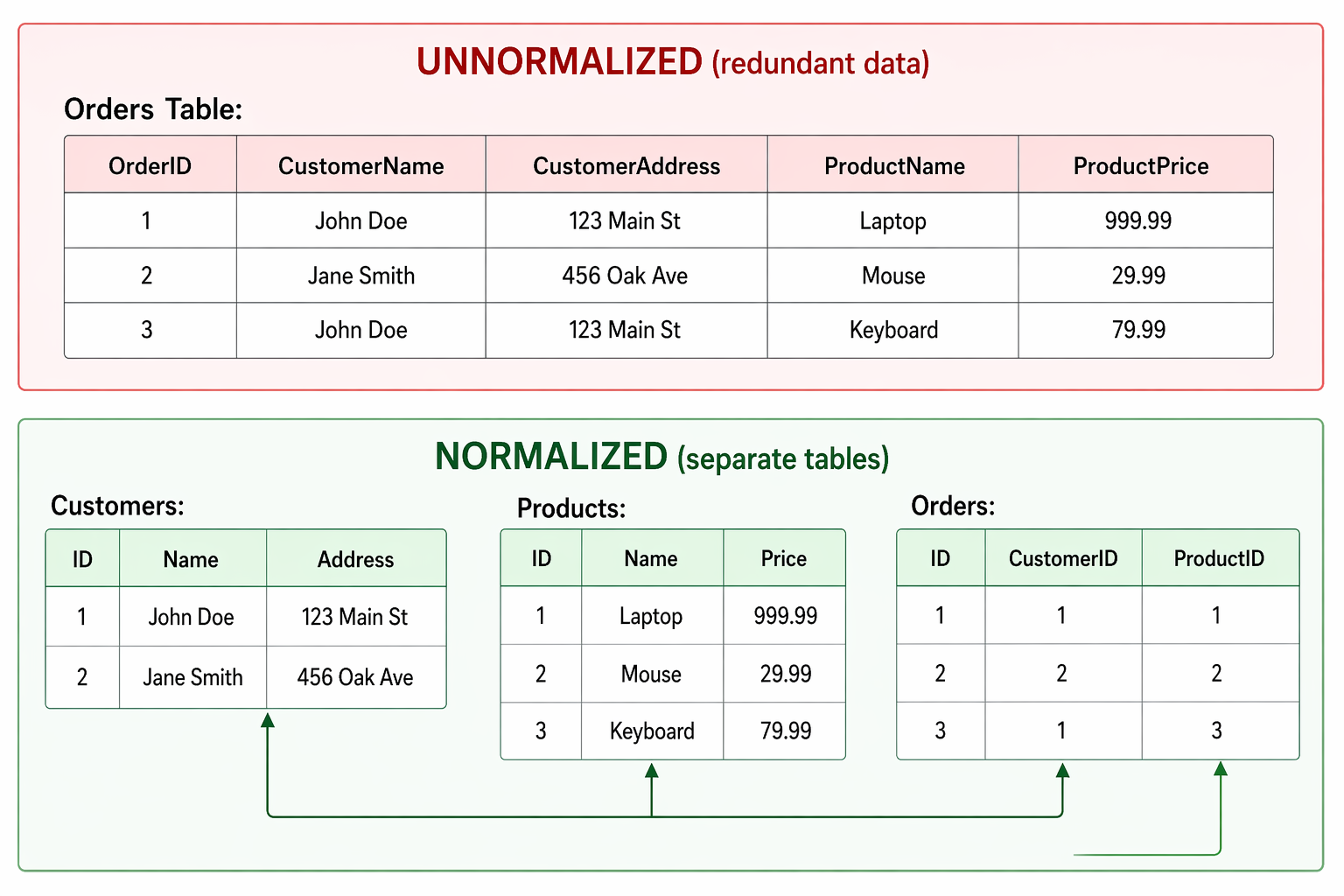
When databases are designed without normalization, data duplication becomes inevitable. The same customer address might appear in hundreds of order records. When that customer moves, updating every occurrence becomes a nightmare, and any missed update creates inconsistent data. Normalization solves this problem by separating data into logical, related tables connected by keys. To understand normalization properly, it is helpful to be familiar with concepts like SQL basics, database indexing, and relational database design.
What Is Database Normalization
Normalization is a systematic approach to designing database schemas that minimizes redundancy and avoids data anomalies. It was developed by Edgar F. Codd, the inventor of the relational model, in the 1970s. The process involves applying a series of rules called normal forms, each building on the previous one.
- Normalization: Organizing data to reduce redundancy and improve integrity
- Normal Forms: Progressive rules that define increasingly strict standards for data organization
- Anomalies: Problems that occur when data is redundant or poorly structured
- Primary Key: Unique identifier for each row in a table
- Foreign Key: Reference to a primary key in another table
Unnormalized vs Normalized data
Why Normalization Matters
Unnormalized databases lead to three types of anomalies that corrupt data integrity. Normalization eliminates these problems by ensuring each fact is stored only once.
- Eliminates Data Redundancy: The same data is not stored in multiple places. When a customer's address changes, you update one row instead of thousands.
- Prevents Insertion Anomalies: You can add a new customer without having an order. In unnormalized designs, you might need a placeholder order to store customer data.
- Prevents Update Anomalies: Updates to redundant data happen in one place, ensuring consistency across all related records.
- Prevents Deletion Anomalies: Deleting a product does not accidentally delete customer information that was stored in the same table.
- Improves Data Integrity: Database constraints enforce relationships, ensuring referential integrity.
- Simplifies Maintenance: Clear table structures make the database easier to understand and modify.
Normal Forms Overview
Normalization is applied through a series of normal forms, each building on the previous. Most practical databases aim for Third Normal Form (3NF), which balances data integrity with query performance.
| Normal Form | Key Requirement | When to Apply |
|---|---|---|
| First Normal Form (1NF) | Each column contains atomic values; no repeating groups | Always |
| Second Normal Form (2NF) | In 1NF, and all non-key columns depend on the entire primary key | Tables with composite primary keys |
| Third Normal Form (3NF) | In 2NF, and no transitive dependencies (non-key depends on non-key) | Most business applications |
| Boyce-Codd Normal Form (BCNF) | Stricter version of 3NF | When 3NF violations exist with overlapping candidate keys |
| Fourth Normal Form (4NF) | No multi-valued dependencies | Rare; specific use cases |
First Normal Form (1NF)
First Normal Form requires that each column contains atomic (indivisible) values and that there are no repeating groups or arrays within a column. Each row must represent a single entity, and each column must hold a single value.
-- VIOLATES 1NF (repeating groups, multi-valued columns)
CREATE TABLE orders (
    order_id INT PRIMARY KEY,
    customer_name VARCHAR(100),
    product_ids VARCHAR(200),     -- Comma-separated list: "1,2,3"
    quantities VARCHAR(100)       -- Comma-separated list: "2,1,3"
);

-- IN 1NF (atomic values, separate rows)
CREATE TABLE orders (
    order_id INT PRIMARY KEY,
    customer_name VARCHAR(100)
);

CREATE TABLE order_items (
    order_id INT,
    product_id INT,
    quantity INT,
    PRIMARY KEY (order_id, product_id)
);
Second Normal Form (2NF)
Second Normal Form builds on 1NF by requiring that all non-key columns depend on the entire primary key, not just part of it. This applies only to tables with composite primary keys (keys made of multiple columns).
-- VIOLATES 2NF (partial dependencies)
-- Composite key: (order_id, product_id)
-- product_name depends only on product_id, not on order_id
CREATE TABLE order_details (
    order_id INT,
    product_id INT,
    product_name VARCHAR(100),    -- Depends only on product_id
    quantity INT,                 -- Depends on full key
    PRIMARY KEY (order_id, product_id)
);

-- IN 2NF (split into two tables)
CREATE TABLE order_items (
    order_id INT,
    product_id INT,
    quantity INT,
    PRIMARY KEY (order_id, product_id)
);

CREATE TABLE products (
    product_id INT PRIMARY KEY,
    product_name VARCHAR(100)
);
Third Normal Form (3NF)
Third Normal Form requires that no transitive dependencies exist. A transitive dependency occurs when a non-key column depends on another non-key column rather than directly on the primary key.
-- VIOLATES 3NF (transitive dependency)
-- product_category depends on product_name, not directly on order_id
CREATE TABLE orders (
    order_id INT PRIMARY KEY,
    customer_name VARCHAR(100),
    product_name VARCHAR(100),
    product_category VARCHAR(50),  -- Depends on product_name
    quantity INT
);

-- IN 3NF (no transitive dependencies)
CREATE TABLE orders (
    order_id INT PRIMARY KEY,
    customer_id INT,
    product_id INT,
    quantity INT
);

CREATE TABLE customers (
    customer_id INT PRIMARY KEY,
    customer_name VARCHAR(100)
);

CREATE TABLE products (
    product_id INT PRIMARY KEY,
    product_name VARCHAR(100),
    category_id INT
);

CREATE TABLE categories (
    category_id INT PRIMARY KEY,
    category_name VARCHAR(50)
);
Normalization in Practice
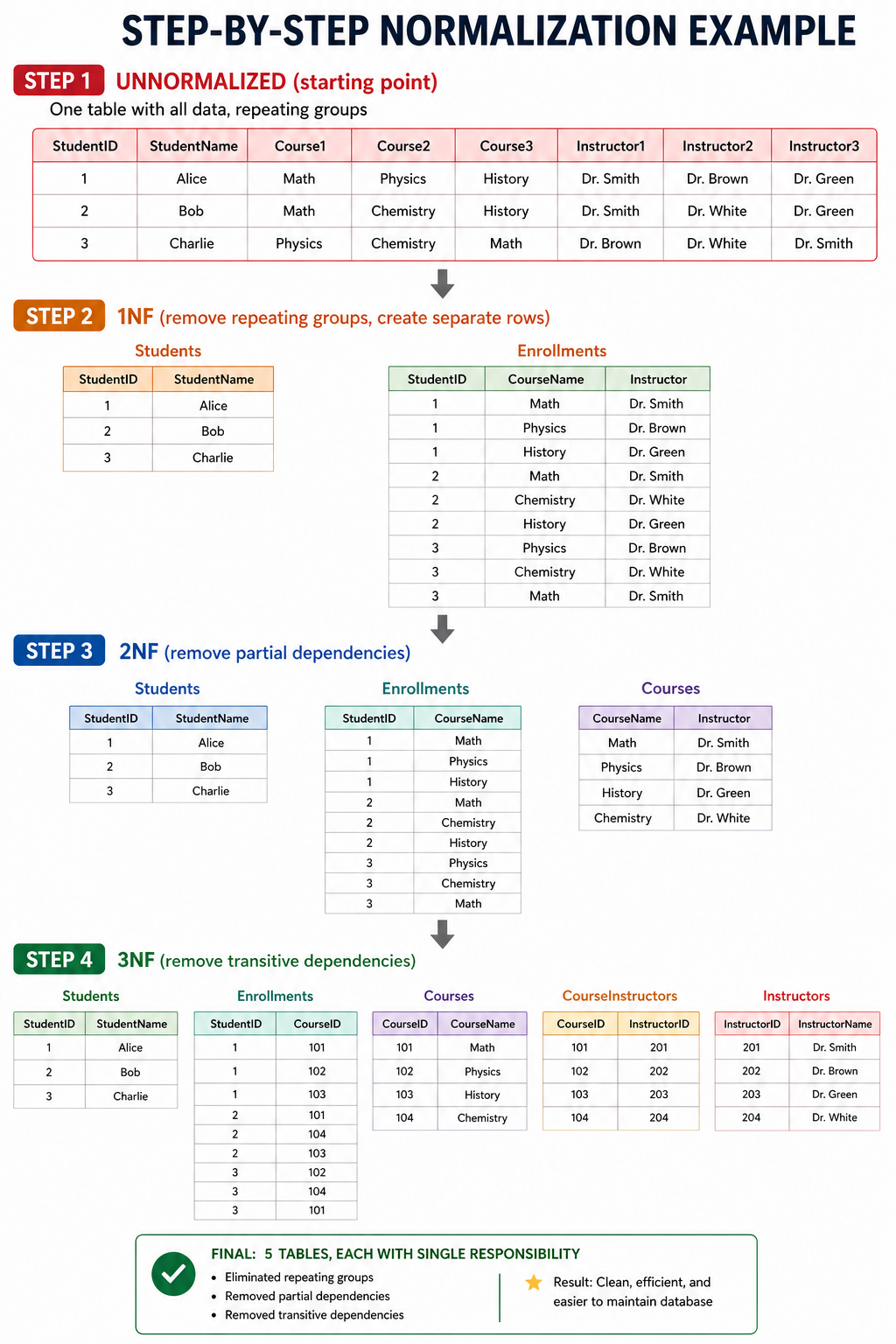
Let's walk through a practical example of normalizing an unnormalized table step by step. This demonstrates how normalization improves data structure incrementally.
Step-by-step normalization example
Denormalization: The Counterpoint
While normalization is the standard for OLTP (Online Transaction Processing) systems, there are valid reasons to intentionally denormalize. Denormalization adds redundancy back into a database to improve read performance for specific queries.
- Reporting and Analytics: Data warehouses and reporting systems often use denormalized schemas to reduce joins for complex queries.
- Read Performance: In read-heavy applications, denormalization can dramatically speed up query response times.
- Materialized Views: Pre-computed aggregates stored for fast access.
- NoSQL Databases: Many NoSQL databases are designed around denormalized, document-based storage.
-- Normalized (requires joins)
SELECT c.name, COUNT(o.id)
FROM customers c
LEFT JOIN orders o ON c.id = o.customer_id
GROUP BY c.id;

-- Denormalized for analytics (adds order_count column to customers)
SELECT name, order_count FROM customers;

-- Trade-off: order_count must be maintained on inserts/updates
-- Benefits: queries become simpler and faster
Normalization and Query Performance
A common concern is that normalization creates many tables and requires joins, potentially slowing queries. In practice, proper indexes make joins extremely fast, and the benefits of data integrity usually outweigh minor performance costs.
- Index Foreign Keys: Always index foreign key columns to make joins efficient.
- Use Database Views: Create views for common queries to simplify code while maintaining normalized storage.
- Materialized Views: For complex aggregations, use materialized views to pre-compute results.
- Consider Query Patterns: Design indexes based on actual query patterns, not just normalization rules.
Normalization Best Practices
Following these best practices helps you apply normalization effectively while avoiding common pitfalls.
- Start with 3NF: For most business applications, Third Normal Form is the target. It provides excellent data integrity without overcomplicating design.
- Use Surrogate Keys: Auto-incrementing integer primary keys are simpler to work with than natural keys and improve join performance.
- Document Relationships: Clearly document foreign key relationships and business rules that inform your design.
- Test with Real Data: Normalization choices should be validated with actual data volumes and query patterns.
- Consider Future Growth: Design for how the database will evolve. Normalization makes schema changes easier.
- Balance Normalization with Performance: In extreme read-heavy scenarios, selective denormalization may be appropriate.
Common Mistakes to Avoid
Even experienced designers make normalization mistakes. Being aware of these pitfalls helps you avoid them.
- Over-Normalization: Splitting data into too many tables creates unnecessary complexity and join overhead. Fourth Normal Form and beyond are rarely needed.
- Under-Normalization: Stopping too early leads to data anomalies and maintenance headaches.
- Ignoring Business Rules: Normalization must reflect actual business relationships. A technically normalized design that ignores business reality fails.
- Natural Key Mistakes: Using natural keys that change over time (like email addresses as primary keys) creates update problems.
- Missing Indexes: Normalized designs require proper indexes on foreign keys. Without them, joins become slow.
- Premature Denormalization: Denormalizing before measuring actual performance issues leads to unnecessary complexity.
Normalization and ORM
When using ORM frameworks, normalized database design aligns perfectly with good object-oriented design. Each normalized table typically maps to a model class, and relationships map to object references.
# Models that mirror normalized tables
class Customer(models.Model):
    name = models.CharField(max_length=100)
    address = models.TextField()

class Product(models.Model):
    name = models.CharField(max_length=100)
    price = models.DecimalField(max_digits=10, decimal_places=2)

class Order(models.Model):
    customer = models.ForeignKey(Customer, on_delete=models.CASCADE)
    order_date = models.DateTimeField(auto_now_add=True)

class OrderItem(models.Model):
    order = models.ForeignKey(Order, on_delete=models.CASCADE)
    product = models.ForeignKey(Product, on_delete=models.CASCADE)
    quantity = models.IntegerField()

# Usage - clean, object-oriented access
customer = Customer.objects.get(id=1)
orders = customer.order_set.all()
for order in orders:
    for item in order.orderitem_set.all():
        print(item.product.name, item.quantity)
Frequently Asked Questions
- Is normalization always necessary?
For transactional systems (OLTP) that require data integrity, normalization is essential. For data warehouses or analytics systems (OLAP), denormalized star schemas are often preferred. Choose based on your use case. - What is the difference between 3NF and BCNF?
Boyce-Codd Normal Form (BCNF) is a stricter version of 3NF. It handles cases where there are overlapping candidate keys. For most applications, 3NF is sufficient. - How do I know if my database is properly normalized?
Review your schema for duplicate data, check for update anomalies, and verify that each table has a single, clear responsibility. If you find yourself updating the same data in multiple places, normalization is likely needed. - Does normalization hurt performance?
Normalization adds join operations but reduces data redundancy. With proper indexing, joins are very fast. The performance benefits of reduced I/O and better caching often outweigh join costs. Measure before denormalizing. - What should I learn next after database normalization?
After mastering normalization, explore database indexing to optimize query performance, database ORM to understand how frameworks map to normalized schemas, and database transaction to maintain data integrity across related tables.
Conclusion
Database normalization is a foundational skill for any developer working with relational databases. By organizing data to eliminate redundancy and prevent anomalies, normalization ensures that your database remains consistent, maintainable, and scalable as your application grows. The principles of normalization apply whether you are designing a schema from scratch or working with an ORM that abstracts away SQL.
The journey from unnormalized to Third Normal Form is about understanding the relationships in your data. Each step reduces duplication and clarifies the structure. While normalization adds tables and requires joins, the benefits of data integrity, simplified maintenance, and flexible querying far outweigh the costs when done correctly.
As you continue building database-backed applications, combine normalization knowledge with related topics like database indexing for performance optimization, database ORM for efficient data access, and REST API design for exposing your data to clients. Together, these skills form a complete foundation for building robust, scalable data-driven applications.