

Introduction
Reliable APIs are essential for modern applications that operate across browsers, mobile apps, and distributed services. In real environments, network conditions are not always stable. Requests may time out, responses may fail to reach the client, or users may accidentally trigger the same action more than once. Because of this, APIs must be designed in a way that prevents unexpected outcomes when the same request is repeated.
Idempotency is one of the most important principles that helps solve this challenge. It ensures that repeating a request does not create duplicate results or change the final state of the system after the first successful execution. This concept is especially important in systems that handle financial transactions, order processing, account updates, or any operation where data accuracy matters.
In REST APIs, idempotency helps maintain trust in the system. When developers design APIs with predictable behavior, applications become more stable, easier to scale, and safer to use in real-world conditions.
Understanding Idempotency in REST APIs
Idempotency describes a behavior where the same operation can be executed multiple times without changing the outcome beyond the initial action. In the context of APIs, this means that sending an identical request more than once should produce the same result as sending it a single time.
Consider a situation where a user updates their account information through an API request. If the network connection is unstable, the client application might retry the request because it is unsure whether the server received it. If the API is idempotent, the server will handle the repeated request safely and ensure that the final data remains correct rather than creating unexpected changes.
This principle allows developers to design systems that tolerate network issues without affecting the integrity of the application. Instead of worrying about duplicate actions, the system maintains a consistent state regardless of how many times the request arrives.
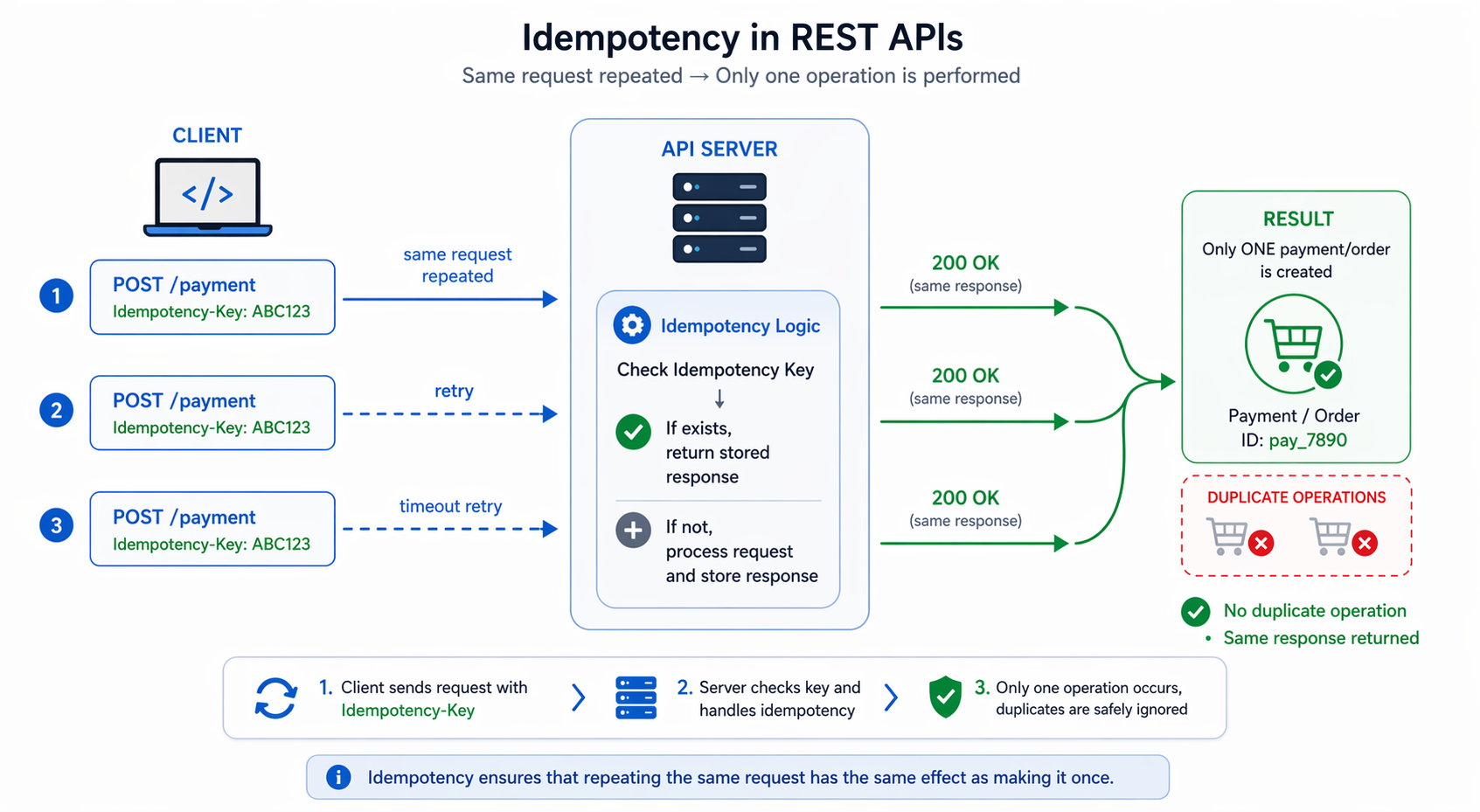
Idempotency ensures that repeated API requests with the same key produce a single consistent result without duplicate side effects.
Why Idempotency Is Important in Modern Web Services
Web services operate in complex environments that include load balancers, caching layers, microservices, and distributed databases. Within this environment, requests may travel through several components before reaching the final service. Because of this, it is possible for the same request to be processed more than once.
If APIs are not designed with idempotency in mind, these repeated requests can cause real problems. Duplicate orders may appear in an e commerce system, multiple payments could be processed for a single purchase, or records in a database might become inconsistent. These issues are difficult to fix once they occur and can negatively affect user trust.
Idempotency acts as a protective layer. It allows systems to safely retry operations when failures occur and ensures that the final result remains predictable. This is particularly valuable in distributed architectures where retry mechanisms are common.
Relationship Between Idempotency and HTTP Methods
In REST architecture, HTTP methods define how clients interact with resources. Each method has a specific purpose and behavior. Some of these methods naturally support idempotent operations while others do not.
Methods such as GET, PUT, and DELETE are generally considered idempotent. When a client requests the same resource multiple times using GET, the server simply returns the same data without modifying it. Similarly, PUT requests are used to update a resource to a defined state, so repeating the same update does not change the final outcome. DELETE requests remove a resource, and once the resource is removed, repeating the same request does not produce a new effect.
POST requests behave differently. POST is typically used to create new resources, which means repeating the same request can result in multiple records being created. Because of this, developers often need additional strategies when using POST for operations that must remain safe under repeated execution.
You can explore how these HTTP methods work in detail here: HTTP Methods
How Idempotency Works in Real API Communication
When a client sends a request to a server, the server processes it and returns a response. In ideal conditions, the client receives the response immediately and continues its workflow. However, in real situations, the response might not arrive due to a temporary network interruption or server delay.
In such cases, the client often retries the request automatically. If the server processes the request again without recognizing it as a duplicate, it may repeat the operation. This can lead to duplicated actions or incorrect data states.
An idempotent API avoids this issue by recognizing that the repeated request represents the same action that has already been processed. Instead of executing the operation again, the server returns the same result that was generated previously. This ensures that the system remains consistent and that no additional changes are introduced by the retry.
Understanding how requests and responses flow between clients and servers helps clarify why idempotency is necessary. You can learn more about this process here: HTTP Request vs Response
Using Idempotency Keys to Prevent Duplicate Actions
A widely used technique for implementing idempotency in APIs is the use of idempotency keys. An idempotency key is a unique value that a client includes in a request. This value allows the server to identify whether the same request has already been processed.
When the server receives a request with an idempotency key, it stores the key along with the result of the operation. If another request arrives with the same key, the server checks its records and returns the previously generated response instead of performing the operation again.
This approach is commonly used in payment processing systems, subscription platforms, and booking applications where duplicate operations must be avoided. By associating each important action with a unique key, the system can safely manage retries without creating additional records.
Designing Idempotent APIs in Practice
Creating idempotent APIs requires careful planning during the design stage. Developers must think about how requests might behave when repeated and ensure that operations lead to a stable final state.
One important step is choosing the correct HTTP method for each operation. When an action involves updating or replacing a resource, methods like PUT are often more suitable because they are naturally idempotent. Developers should also structure their APIs so that the same input consistently produces the same outcome.
Another key practice is tracking requests that perform critical actions. By storing identifiers or request keys, the system can detect duplicates and prevent repeated processing. This is particularly important in operations that involve financial data, user accounts, or transactions.
Additionally, APIs should be designed with clear and predictable responses. When the server returns consistent responses for repeated requests, client applications can handle retries more confidently without introducing errors.
Common Challenges When Implementing Idempotency
Although the concept of idempotency is straightforward, implementing it in large systems can present challenges. One common issue occurs when developers use POST requests for operations that should not create duplicates. Without additional safeguards, repeated POST requests may generate multiple entries in a database.
Another challenge appears in distributed systems where multiple servers handle incoming requests. In such environments, tracking idempotency keys or request history must be handled carefully to ensure consistency across all servers.
Developers must also consider how long idempotency records should be stored. Keeping them for too short a period may allow duplicates to occur later, while storing them indefinitely may increase system complexity. Finding the right balance is an important part of API design.
Real World Use Cases of Idempotent APIs
Many well known platforms rely on idempotent APIs to ensure stable operations. Payment gateways use idempotency to prevent customers from being charged multiple times if a payment request is retried. Online stores apply the same concept to avoid duplicate order creation during checkout processes.
In account management systems, idempotency helps maintain consistent user data when profile updates are submitted more than once. Cloud services and large scale platforms also depend on idempotent operations to ensure reliability across distributed infrastructure.
These real world examples demonstrate how idempotency supports both user experience and system stability.
Conclusion
Idempotency plays a central role in designing reliable REST APIs. It ensures that repeated requests do not produce unexpected outcomes and that systems remain consistent even when network issues occur. By understanding how idempotent operations work and applying them carefully, developers can create APIs that behave predictably under real world conditions.
Strong API design involves choosing the right HTTP methods, implementing mechanisms such as idempotency keys, and ensuring that operations lead to a stable final state. When these practices are followed, web services become more dependable and easier to scale.
As modern applications continue to grow in complexity, the importance of idempotency will only increase. Developers who understand and apply this concept will be better prepared to build secure, stable, and efficient web systems.









Comments (4)
No comments yet
Be the first to share your thoughts!
Post Your Comment Here: