

I watched a user abandon a twelve hundred dollar shopping cart last month. Not because the product was wrong. Not because the price was too high. Not because a competitor offered something better. They abandoned because the checkout form rejected their legitimate apartment number as invalid, displayed a cryptic error message that offered no solution, and then cleared three other fields when they tried to fix it. That user is never coming back. The edge case cost that business twelve hundred dollars in about ninety seconds. Multiply that across thousands of users encountering their own personal edge cases, and the math becomes brutal.
Most product teams treat edge cases as something to handle later. The happy path gets the design reviews and the stakeholder signoff and the polished prototypes. Edge cases get a shrug and a promise to address them if they ever become real problems. This is backwards. The happy path is what every competent product gets right. The edge cases are where users actually live. Real users have spotty connections and outdated browsers and unusual names and complex addresses and workflows you never anticipated. They use your product while distracted and tired and on devices you never tested. When your product fails them in those moments, they do not file bug reports. They leave. The products that feel reliable and professional are not the ones with the smoothest happy paths. They are the ones that do not fall apart when conditions get messy.
Edge Cases Are Not Exceptions. They Are the Reality of Usage at Scale.
The term edge case creates a framing problem. It suggests something rare and peripheral, a statistical outlier that affects only a tiny fraction of users. This is true only if you define each edge case narrowly in isolation. But edge cases are not isolated. They compound. The user with an unusual address format is also on a slow connection. They are also using an older browser. They are also in a hurry. Each individual condition might affect only a small percentage of users. The overlap of multiple conditions affects a much larger group than the math suggests.
Consider a checkout flow with ten potential edge cases: invalid postal code format, expired session, declined payment method, out of stock item, coupon code that no longer applies, address that fails validation, network timeout during submission, browser that does not support a required feature, screen reader that cannot parse the error summary, and a user who needs to switch payment methods mid-flow. The probability that any single user encounters any specific edge case is low. The probability that a user encounters at least one edge case across their lifetime of using the product is nearly one hundred percent. Edge cases are not exceptions. They are the steady state of usage at scale.
Designing only for the happy path means accepting that a meaningful percentage of user sessions will end in frustration. The product works beautifully in design reviews and stakeholder demos and conference room WiFi. It fails in the real world, where conditions are never ideal. Great products are not great because they are more innovative or more beautiful or more feature-rich than their competitors. They are great because they do not abandon users when things go wrong. The difference is not visible in a side-by-side feature comparison. It is felt cumulatively across dozens or hundreds of interactions.
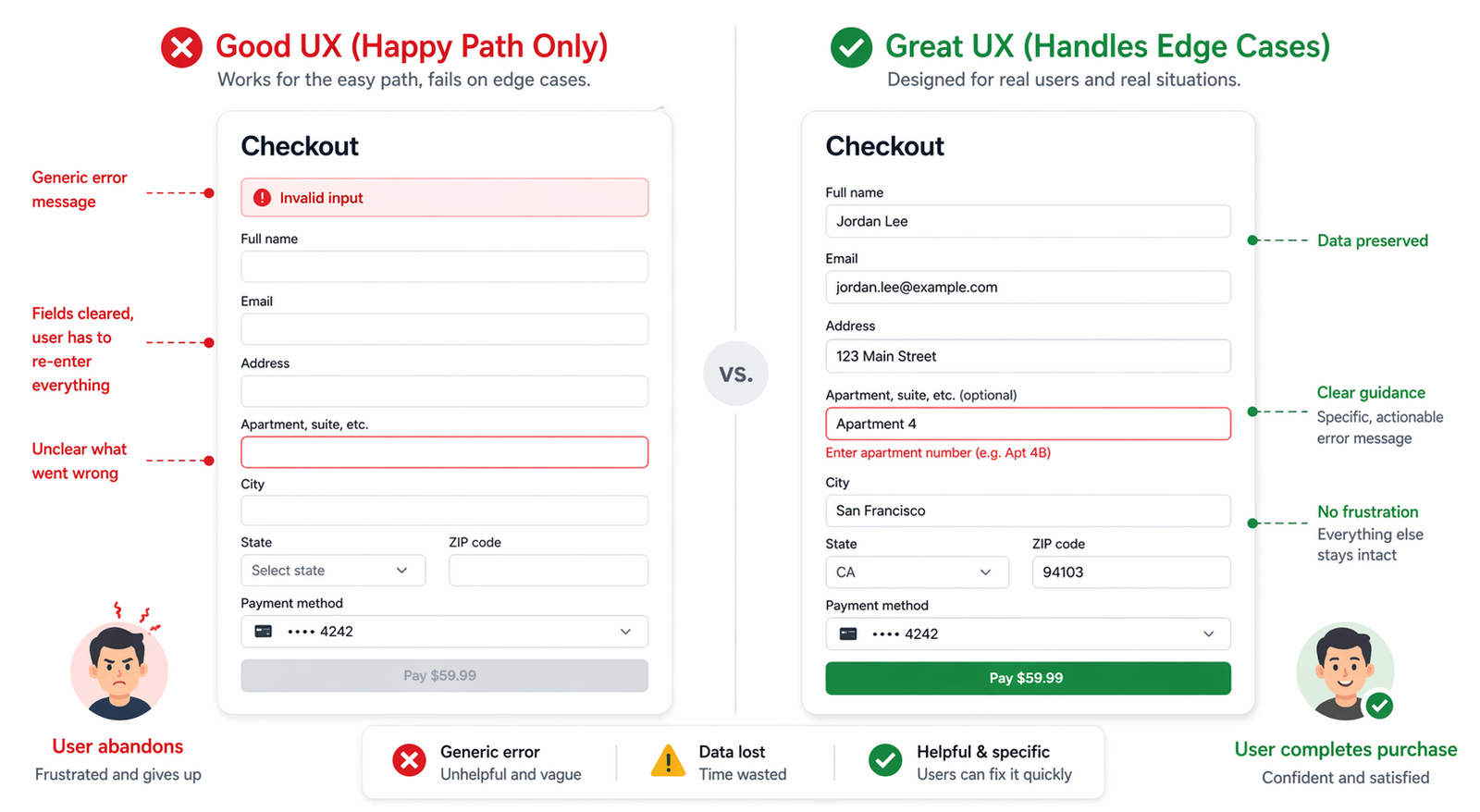
Great UX is defined by how well it handles edge cases, not just the happy path.
What Edge Case Design Actually Requires
Designing for edge cases is not about adding more screens or more error messages. It is about making the system resilient to variation and clear about recovery. A form that rejects an address format should preserve everything else the user entered. A search that returns zero results should suggest alternatives rather than displaying an empty void. A network failure should queue the user's action for retry rather than discarding it into nothing. A validation error should highlight the specific field that needs attention and explain what format is expected. These are not complex features. They are basic affordances that signal respect for the user's time and effort.
The reason edge cases are neglected is not technical difficulty. It is that they are invisible during normal testing. Designers testing their own flows enter valid data and follow the intended path. Developers testing their own code use the happy path because that is what they built. Stakeholders reviewing the product see the polished demo and assume the rest works. No one is assigned to test what happens when things go wrong. No one is measured on how gracefully the product handles failure. The organizational incentives point entirely toward the happy path, so the happy path is what gets attention.
Fixing this requires a deliberate shift in how products are evaluated. Edge case handling must become part of the definition of done. Design reviews must include explicit discussion of failure states and recovery paths. User testing must include scenarios where things go wrong. Metrics must track not just successful completions but also abandonment reasons and error frequency. When edge cases are measured, they get fixed. When they are invisible, they accumulate until the product feels unreliable in ways users cannot articulate but definitely feel.
| Edge Case Category | Good UX Response | Great UX Response | What Users Actually Experience When This Fails |
|---|---|---|---|
| Invalid form input | Show error message near the field | Preserve all other entered data; show example of valid format; highlight specific field | Form clears entirely; generic error; user abandons |
| Network timeout | Display connection error | Queue action for automatic retry; show progress indicator; allow manual retry | Spinner spins forever; user refreshes and loses work |
| Zero search results | Display "no results found" | Suggest related terms; show popular alternatives; provide filtering options | Empty void; user assumes product does not have what they need |
| Session expiration | Redirect to login | Preserve intended destination; restore state after re-authentication | User logs in to empty state; abandons original intent |
| Out of stock item in cart | Notify user at checkout | Notify immediately; suggest alternatives; save item for later; preserve cart state | User discovers at final step; feels bait-and-switched; abandons entirely |
The ROI of Handling Edge Cases Properly
Edge case design is often framed as a cost. It takes time to identify failure scenarios and design recovery paths and implement graceful handling. That time could be spent building new features that stakeholders can see and celebrate. The return on investment is harder to quantify because it shows up as absence rather than presence. Fewer support tickets. Lower abandonment rates. Higher retention among users who never experience the friction that drives others away. These are real business outcomes, but they do not appear in roadmap presentations with the same clarity as a new feature launch.
The math becomes clearer when you work backwards from lost revenue. An ecommerce site with a sixty percent cart abandonment rate that reduces that rate by five percentage points through better edge case handling adds significant revenue without acquiring a single new visitor. A SaaS product that reduces churn by two percentage points because users encounter fewer frustrating dead ends compounds that retention gain across every renewal period. The investment in edge case design pays for itself many times over. The challenge is that the payoff is distributed and delayed while the cost is immediate and visible.
The products that become category leaders are rarely the ones with the most features or the most beautiful interfaces. They are the ones that feel reliable. Users trust them because they have learned, often subconsciously, that the product will not abandon them when something goes wrong. That trust is built one edge case at a time, through thousands of small recoveries that users never consciously notice but would definitely notice if they failed. Great UX is not about delighting users with clever animations or witty copy. It is about never giving them a reason to stop trusting you.
Building Edge Case Awareness Into Your Process
Edge case design cannot be a phase that happens after the happy path is complete. It must be integrated into the design process from the beginning. This starts with simple habits. During design reviews, ask what happens if the network fails here. Ask what happens if this data is missing or malformed. Ask what happens if the user needs to go back and change something later. Ask what happens if they are using a screen reader or a keyboard only. These questions take seconds to ask and can prevent hours of rework later.
User testing must include edge case scenarios explicitly. Recruit users with varied devices and network conditions and accessibility needs. Create tasks that involve recovering from errors rather than just completing happy paths. Observe what users actually do when things go wrong, not what you assume they will do. The gap between assumed behavior and actual behavior is often where the most valuable insights live. Users do not read error messages carefully. They do not follow recovery steps in order. They try random things until something works or they give up. Design for that reality, not for the idealized user who calmly follows instructions.
Metrics must capture edge case frequency and impact. Track form abandonment by field. Track search queries that return zero results. Track session expirations during active workflows. Track retry rates and their outcomes. When you measure edge cases, you can prioritize them based on actual impact rather than assumption. A failure that affects two percent of users might seem minor until you realize those users represent your highest-value segment. A timeout that occurs primarily on mobile might explain why mobile conversion lags desktop despite identical designs. Data turns edge cases from invisible annoyances into addressable opportunities.
The products that users love are not perfect. They fail constantly in ways users never see because those failures are handled before they become user problems. The network request that silently retries. The form that preserves state across page reloads. The search that finds something useful even when the query is messy. These are not features that appear in marketing materials. They are the invisible infrastructure of trust that makes everything else possible. Design for the edge cases, and the happy path takes care of itself. Ignore them, and no amount of happy path polish will save you from the slow erosion of user confidence that eventually becomes impossible to reverse.






Comments (1)
No comments yet
Be the first to share your thoughts!
Post Your Comment Here: