
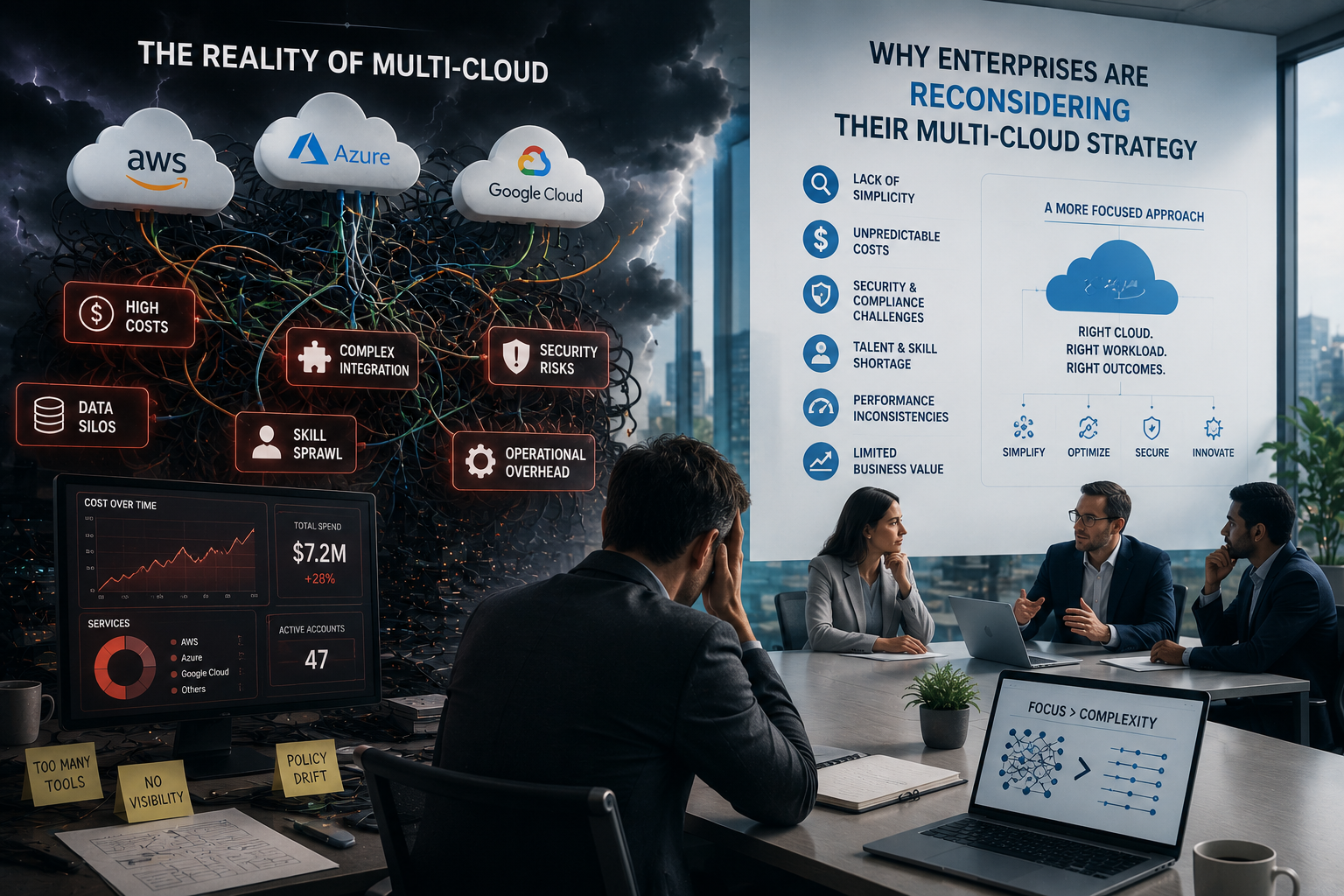
Multi-cloud was sold as freedom. Freedom from vendor lock-in, freedom from single-provider pricing power, freedom from the existential risk of betting the entire infrastructure estate on one company's continued competence. The pitch was compelling enough that enterprises spent years and millions of dollars distributing workloads across AWS and Azure and Google Cloud, building abstraction layers that promised seamless portability, training engineers on three different platforms, and celebrating their architectural sophistication at conferences where multi-cloud case studies drew the biggest audiences. What nobody mentioned during those presentations was the operational reality of running critical systems across providers that were never designed to work together.
The reversal is not yet widespread enough to call it a trend, but the early signals are unmistakable. Enterprises that invested most aggressively in multi-cloud are quietly consolidating. Not to a single provider in every case, but away from the ambition of seamless portability toward something more pragmatic. They are picking a primary platform and using secondary providers only where specific capabilities justify the complexity. The promised benefits of multi-cloud turned out to be real in theory and nearly impossible to realize in practice. The costs were higher than projected. The resilience gains were smaller than advertised. And the freedom from vendor lock-in was mostly an illusion purchased at the expense of locking into a different set of constraints that nobody warned them about.
Portability Is a Fantasy Nobody Actually Needs
The central promise of multi-cloud was workload portability. Build once, deploy anywhere. When AWS raises prices or suffers an outage or falls behind on a capability you need, simply move the affected workloads to Azure or Google Cloud with minimal friction. This promise required an abstraction layer that would insulate applications from provider-specific services. Every team that attempted to build this abstraction layer discovered the same uncomfortable truth: the abstraction itself became the most complex component in the system, and it never actually worked well enough to enable the seamless migration that was its entire reason for existing.
Provider-specific services are not interchangeable. They have different APIs and different performance characteristics and different failure modes and different operational behaviors. The abstraction layer that hides these differences also hides the capabilities that made each provider worth using in the first place. Teams end up targeting the lowest common denominator, using only features available across all providers, which means using none of the differentiated capabilities that any individual provider offers. The result is a system that is technically portable but operationally mediocre. It runs everywhere and excels nowhere. The abstraction layer that was supposed to provide freedom became the constraint that prevented the team from using any provider effectively.
The enterprises that are consolidating have accepted that true workload portability is neither achievable nor necessary. The scenarios where migrating a running workload between providers on short notice actually matters are vanishingly rare. Provider outages, while real, are typically short enough that multi-region deployment within a single provider provides sufficient resilience. Price increases, while annoying, are rarely large enough to justify the operational cost of maintaining multi-cloud capability as a negotiating tactic. The business case for portability assumed threats that did not materialize and underestimated the cost of the solution.
Expertise Does Not Scale Across Providers
Each cloud provider is a sprawling ecosystem of services with deep integration patterns and subtle behavioral characteristics that only become visible through extended operational experience. An engineer who knows AWS deeply understands not just the API calls but the failure modes of specific services and the performance implications of different configuration choices and the undocumented behaviors that incident responders learn only through hard experience. That depth of knowledge does not transfer to Azure or Google Cloud. The services have different names and different guarantees and different operational characteristics. An engineer who splits their attention across three platforms develops breadth at the expense of depth, becoming competent on all three without being expert on any.
This dilution of expertise creates operational risk that compounds over time. When an incident occurs on a secondary platform, the engineer responding to it has less accumulated experience with that platform's specific failure modes. The debugging takes longer. The recovery is less certain. The risk of making the situation worse through unfamiliarity with platform-specific behaviors is higher. The organization has more platforms to manage but less expertise to manage any single one of them effectively. The resilience that multi-cloud was supposed to provide is undermined by the operational fragility that divided expertise creates.
Consolidating on a primary platform concentrates expertise where it generates the most value. Engineers develop deeper knowledge of the platform's capabilities and limitations. Incident response becomes faster and more reliable. Optimization opportunities that are invisible to generalists become apparent to specialists. The organization trades the theoretical resilience of provider diversity for the practical resilience of deep operational competence. For most enterprises, this trade is worth making. The scenarios where provider diversity prevents an outage are less common than the scenarios where insufficient platform expertise causes or prolongs one.
The Cost Story Nobody Told
Multi-cloud was marketed as a cost optimization strategy. Run workloads on whichever provider offers the best price for that particular workload type. Take advantage of committed-use discounts by balancing capacity across providers. Use the threat of migration to negotiate better pricing from your primary provider. The spreadsheet math for these strategies looks compelling. The operational reality adds costs that the spreadsheet never captured.
Data egress charges alone undermine many multi-cloud cost models. Moving data between providers is expensive, and many architectures that distribute workloads across providers require significant cross-provider data transfer. The networking complexity of connecting multiple cloud environments reliably and securely adds infrastructure costs and engineering overhead. The compliance burden of maintaining security posture across multiple platforms with different control frameworks and different audit requirements multiplies the effort required for certifications and assessments. The tooling costs for monitoring and observability and deployment automation that work across providers exceed the costs of provider-specific tooling. Each of these costs is individually defensible. Together, they erode or eliminate the savings that the spreadsheet projected.
The enterprises that are consolidating have done the actual accounting. Not the projected accounting that justified the original multi-cloud investment, but the realized accounting after years of operational experience. The cost of multi-cloud was higher than expected. The savings were lower. The negotiating leverage with providers was less valuable than anticipated because the operational cost of actually migrating workloads between providers exceeded the pricing differential that the negotiation was meant to address. The business case for multi-cloud relied on assumptions about costs and benefits that operational experience did not validate.
What the Consolidators Are Doing Instead
The enterprises that are pulling back from multi-cloud are not returning to the naive single-provider strategies of a decade ago. They are adopting a pragmatic primary-provider model that preserves genuine benefits of multi-cloud while eliminating the costs that delivered no value. A primary provider hosts the majority of workloads and receives the majority of engineering investment. The team develops deep expertise on that platform. The architecture takes advantage of platform-specific services rather than avoiding them for portability. The operational tooling is optimized for the primary environment rather than compromised to support multiple environments.
Secondary providers are used selectively for specific capabilities that the primary provider does not offer or does not offer competitively. A machine learning workload might run on Google Cloud because the ML services are superior. A legacy Windows workload might run on Azure because the integration with existing Microsoft infrastructure justifies the operational overhead. These are not multi-cloud strategies in the original sense. They are best-tool-for-the-job decisions made with clear understanding of the operational cost of each additional provider. The default is the primary platform. Deviation requires justification.
This model preserves the genuine benefit of multi-cloud, access to differentiated capabilities across providers, while eliminating the costs that delivered no value. The abstraction layers disappear. The lowest-common-denominator architecture disappears. The divided expertise disappears. What remains is a clear primary platform with deep operational competence and selective use of secondary platforms where the capability justifies the complexity. This is not multi-cloud as it was originally conceived. It is something more practical, and the enterprises adopting it are discovering that practical beats ideological every time.
The Lock-In That Actually Matters
The irony of the multi-cloud movement is that it was driven by fear of vendor lock-in while creating a different and more damaging form of lock-in. The abstraction layers and cross-platform tooling and lowest-common-denominator architectures that multi-cloud required became their own form of lock-in, not to a vendor but to a set of technical decisions that were justified by a business case that never materialized. Moving off the multi-cloud abstraction layer is as difficult as moving off any single provider, perhaps more difficult because the abstraction was internally developed and internally maintained and carries the accumulated complexity of years of internal engineering investment.
The enterprises that are consolidating are discovering that the lock-in they feared was less damaging than the lock-in they built. Provider lock-in is mitigated by the fact that providers have strong incentives to maintain compatibility and reasonable pricing. The cost of switching providers, while real, is bounded and predictable. The lock-in to an internally built multi-cloud abstraction layer has no such mitigation. The cost of unwinding it is whatever the accumulated engineering decisions made it. For some enterprises, that cost exceeds what it would have cost to migrate between providers several times over.
The lesson is not that multi-cloud is always wrong. It is that the decision to adopt multi-cloud should be subject to the same scrutiny as any major architectural investment. The benefits should be measurable and the costs should be accounted honestly. The business case should survive contact with operational reality. For too many enterprises, multi-cloud was adopted as a strategic imperative rather than an architectural decision. It was assumed to be the right answer without being evaluated against alternatives. The enterprises that are reconsidering are not abandoning multi-cloud entirely. They are subjecting it to the analysis it should have received before millions of dollars were spent implementing it. The result of that analysis, for many, is a strategy that looks less like the multi-cloud vision of five years ago and more like a pragmatic acceptance that complexity has a cost and that cost must be justified by genuine, measurable benefit.






Comments (0)
No comments yet
Be the first to share your thoughts!
Post Your Comment Here: