

Feature flags are sold as a mark of engineering sophistication. They promise safer deployments, cleaner separation of release from deploy, and the freedom to experiment without fully committing to anything. Teams that use them extensively are held up as mature, forward thinking, and operationally disciplined. The narrative is clean and compelling. The reality is messier and far less flattering.
In too many organizations, feature flags serve a purpose nobody wants to name out loud. They hide decisions that teams were not ready to make, not willing to make, or not aligned enough to make together. They paper over the uncomfortable gaps between what product wants, what engineering can build, what UX believes is right, and what leadership is actually willing to commit to. The flag becomes the compromise that lets everyone move forward without anyone having to say yes or no definitively. And because nobody says no, nobody has to take responsibility for the outcome.
Over time, this creates a widening chasm between what the product intends to be, what users actually experience, and what the organization believes it has shipped. The software looks flexible on the surface. Underneath, it accumulates ambiguity like sediment, layer after layer of unresolved choices encoded as conditional logic that nobody fully understands anymore.
The Promise That Started It All
Feature flags entered the engineering mainstream to solve genuine and significant problems. They allow teams to deploy code to production without immediately exposing that functionality to users. This separation of deployment from release reduces the blast radius of failed changes and enables gradual rollouts where a small percentage of traffic sees new behavior before the full user base is exposed. They support experimentation frameworks that let teams compare variants and measure impact before committing to a direction. They give operations teams the ability to disable problematic features without rolling back entire deployments, a capability that has prevented countless incidents from becoming full scale outages.
When used with clear intention and disciplined lifecycle management, feature flags function as a coordination mechanism that aligns engineering velocity with product safety and operational stability. They create space for teams to observe real user behavior before making irreversible changes, to gather evidence before forming convictions, and to learn cheaply rather than expensively. This is the version of feature flags that conference talks celebrate and engineering blogs document. It is real. It works. And it represents a tiny fraction of how flags actually get used in practice.
When Temporary Becomes Permanent Without Anyone Noticing
The trouble begins quietly, almost imperceptibly, when feature flags stop being temporary instruments of controlled change and start becoming permanent fixtures embedded in the codebase like archaeological layers from decisions nobody remembers making. Instead of representing a short lived experiment with a defined hypothesis and a planned conclusion date, flags become enduring infrastructure. Decisions get deferred indefinitely because deferral is easier than alignment. No single person or team owns the question of whether the feature should continue existing, how it should behave in edge cases, or who it is ultimately meant to serve. The flag persists not because it is still needed but because removing it would require a conversation that the organization has successfully avoided having for months or years.
The flag remains in the code because removing it would mean deciding. And deciding would mean confronting the disagreements, the ambiguity, and the tradeoffs that the flag was originally deployed to sidestep. So the flag stays. And another flag gets added next sprint. And another the sprint after that. Each one represents a small act of organizational avoidance that compounds into something far larger than the sum of its parts.
Product Ambiguity Encoded as Conditional Logic
Every feature flag encodes a product decision whether that decision was made consciously or not. Who should see this feature. When should they see it. Under what conditions should it activate. What should happen when those conditions are not met. These are not merely technical configuration questions. They are statements about product strategy, user segmentation, and the intended experience. When those underlying decisions remain unresolved, the code itself becomes a substitute for clarity. Conditional logic replaces explicit agreement. Branches in the codebase paper over branches in organizational alignment.
Rather than deciding definitively whether a feature is ready for all users, whether it solves a real problem, or whether it represents the right direction for the product, teams ship multiple realities simultaneously and let the flag decide based on whatever criteria seemed reasonable at the time of implementation. The product technically works. Requests return responses. Buttons render. Screens load. And yet the product lacks any coherent direction because it is simultaneously trying to be multiple different things to multiple different audiences based on logic that no single person fully understands anymore.
The UX Cost That Users Actually Feel
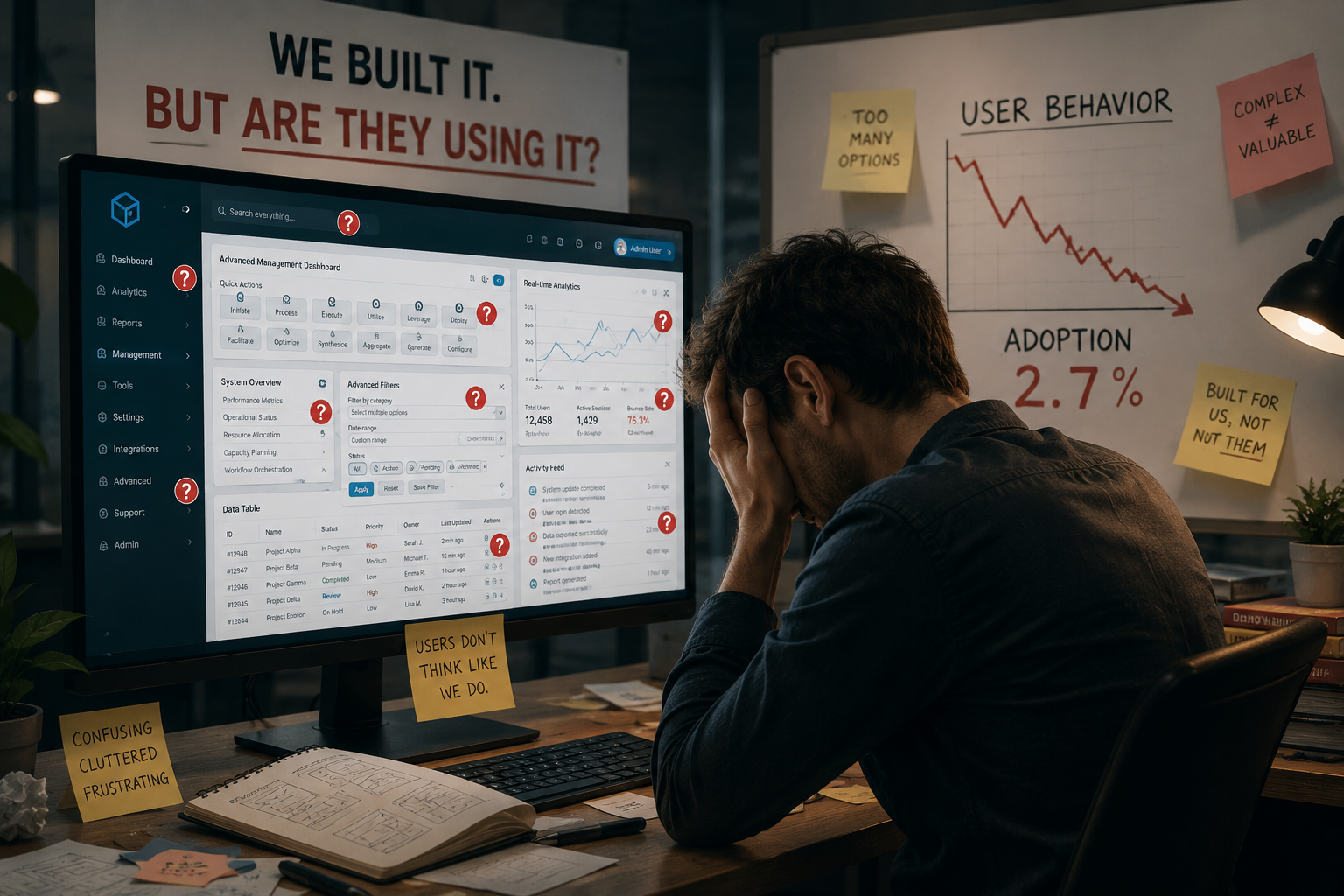
From the perspective of someone actually using the product, feature flags manifest most visibly as inconsistency that erodes trust and increases cognitive load. Two users sitting next to each other see different interfaces and cannot understand why. Documentation describes behavior that does not match what appears on screen. Support teams cannot reliably reproduce reported issues because the product behaves differently depending on invisible conditions that even the support team cannot see without engineering assistance. Users encounter features that appear one day and vanish the next, or that behave differently between sessions, or that contradict workflows they had previously established and relied upon.
The user experience was not intentionally designed to be fragmented and confusing. No designer set out to create an interface that gaslights users about what the product actually does. The fragmentation emerges as an unintended but entirely predictable consequence of unresolved decisions accumulating in the codebase. Each flag adds another dimension of possible variance. The combinatorial explosion of possible experiences exceeds any team's ability to test, document, or even conceptualize. Users become unwilling participants in experiments they never consented to, navigating a product whose behavior feels arbitrary because, at the level of organizational decision making, it actually is.
Common symptoms of flag-induced UX fragmentation include:
- Inconsistent navigation or layout across accounts that should be identical but render differently based on flag assignments no one documented
- Features appearing without explanation or context because the onboarding flow was never built for the flag-enabled variant
- Help content that does not match the interface because documentation teams cannot keep pace with the combinatorial explosion of possible experiences
- Unexpected regressions during rollouts that surprise even the teams executing them because the interaction between flags was never tested
- Support teams unable to reliably reproduce issues because the state space is too large to navigate without engineering assistance
These problems are rarely traced back to their root cause in decision debt. They are treated as bugs to be fixed individually rather than symptoms of a systemic pattern that will continue generating new bugs indefinitely until the underlying pattern changes.
Engineering Complexity That Multiplies in Silence
From the engineering perspective, each feature flag introduces new branching logic that multiplies the possible states the system can inhabit. A system with five independent boolean flags can exist in thirty two distinct configurations. Ten flags produce over a thousand. Twenty flags produce over a million. The numbers become absurd quickly, but the cognitive load on engineers grows even faster because the interactions between flags are rarely independent. Certain combinations make no sense together. Others produce subtle bugs that only manifest when specific flags align in specific ways under specific traffic patterns. Testing becomes combinatorially impossible. Reasoning about system behavior slows to a crawl as engineers must mentally simulate flag combinations before understanding what code will actually execute.
Over time, a strange and damaging dynamic takes hold. Engineers stop fully understanding how the system behaves under all combinations of flags because fully understanding is no longer possible within human cognitive limits. Fear replaces confidence. Changes become scary not because the code is bad but because the possible consequences are unknowable. The system appears flexible from the outside. From the inside, it has become rigid and fragile, held together by accumulated conditional logic that nobody dares to touch.
Why Flags Feel Easier Than Decisions
Feature flags are appealing in the moment because they reduce immediate friction between teams and stakeholders who disagree. They allow forward progress without requiring the difficult work of resolving disagreements between product management, user experience design, marketing, engineering leadership, and executive stakeholders. Everyone gets to move forward. No one has to say no definitively. No one has to say yes with full commitment either. The decision is postponed to some future date that never arrives. The illusion of progress satisfies the immediate need to show momentum while the underlying alignment work remains undone.
The cost of this deferral is not eliminated. It is merely shifted forward in time, where it compounds with interest. Each postponed decision makes future decisions harder because the system has grown more complex and the number of stakeholders with vested interests has increased. The organizational debt accumulates alongside the technical debt, and both become harder to unwind the longer they persist.
Organizational incentive structures often reinforce this pattern rather than correcting it. Product teams are rewarded for shipping features, not for achieving clarity about which features actually matter. Engineering teams are rewarded for avoiding outages, not for maintaining conceptual integrity of the codebase. User experience teams are rewarded for advocating for consistency, but they are often brought in too late to influence the decisions that would have prevented fragmentation. Feature flags become the compromise that temporarily satisfies everyone while permanently satisfying no one. And because the temporary satisfaction feels good in the moment, the pattern repeats.
Reality Splits Into Irreconcilable Versions
As flags accumulate and decisions remain unmade, something strange happens to the organization's collective understanding of its own product. Different groups begin operating against different versions of reality. The sales team demonstrates one experience during customer calls because that is what the flag configuration shows them. The support team sees a different experience because their accounts have different flag assignments. Internal employees see a third version that combines flags intended for testing. Analytics systems aggregate all of these fragmented experiences together into metrics that represent no actual user's journey through the product.
No single version of the product represents ground truth anymore. The organization has splintered into factions that each believe they understand what was built, but those understandings are incompatible with each other. Learning becomes nearly impossible because metrics blend incompatible states into averages that describe nothing real. The product becomes difficult to steer because the feedback loops between action and outcome have been severed by layers of conditional complexity.
The Questions Feature Flags Allow Teams to Avoid
Every permanent feature flag represents a conversation that never happened. The questions that should have been asked and answered before the flag was created remain unanswered indefinitely, and the flag serves as a monument to that avoidance. The most important avoided questions include:
- Is this feature actually solving a user problem or is it solving an internal disagreement about what to build?
- Who is responsible for its long term behavior and who gets paged when it breaks in production?
- What does success look like and how will we know when we have achieved it or failed to achieve it?
- What happens if we remove it and who would notice and what would they lose?
- Is the experience coherent without internal context or does it only make sense to people who were in the room when it was designed?
When these questions remain unanswered, flags become hiding places for ambiguity that the organization was not prepared to confront. The flags themselves are not the root cause. They are the visible evidence of deeper patterns of avoidance that shape how the organization makes decisions or fails to make them.
Experiments That Were Never Designed to End
Experiments are meant to conclude. They should produce learning, inform a decision, and then be removed from the system once that learning has been absorbed. Many feature flags that are labeled as experiments in documentation never reach that conclusion. No one schedules the decision meeting because the calendar is already too full. No one feels confident interpreting the data because the metrics are noisy and the sample sizes are ambiguous. No one wants to be responsible for making the wrong call based on incomplete information. The flag remains not because it is still generating useful learning but because uncertainty feels safer than commitment. The experiment ossifies into permanent ambiguity, and the organization loses the ability to distinguish between things that are being tested and things that are simply unfinished.
Metrics That Lose Their Meaning
Metrics and analytics systems assume stable behavior that can be measured and compared over time. When feature flags fragment the user experience into dozens or hundreds of incompatible variants, metrics aggregate those incompatible states into averages and trends that describe no actual user's experience. Conversion rates blend users who saw completely different interfaces. Retention metrics reflect mixed workflows that cannot be meaningfully compared. Engagement numbers combine apples and oranges and produce numbers that look precise but signify nothing.
Teams make decisions based on these noisy signals without realizing the source of the noise. They optimize for metrics that are actually measuring the average of incompatible experiences rather than any coherent product direction. The system becomes difficult to steer because the instruments have been decoupled from reality. The organization is flying blind while believing it has sophisticated instrumentation.
The Maintenance Burden Nobody Budgeted For
Each feature flag imposes an ongoing maintenance burden that is rarely acknowledged in planning conversations. Documentation must explain what the flag controls, what values are valid, and what behavior to expect under different configurations. Tests must account for the flag's existence, ideally covering both enabled and disabled paths, which multiplies the test matrix with each new flag added. Engineers must remember that the flag exists when debugging issues or designing new features that might interact with it. New team members must learn the flag's purpose and behavior during onboarding, a process that becomes less effective as the number of flags grows beyond what any individual can reasonably retain.
Most organizations never allocate dedicated time to remove flags. Sprint planning focuses on building new things, not on cleaning up old things. The backlog of flag cleanup tasks grows indefinitely, and because the tasks are never urgent enough to displace feature work, they are never completed. Flags accumulate like sediment, slowing everything built on top of them and making the entire system harder to change over time.
The long term risks introduced by unbounded flag accumulation include:
- Unbounded conditional complexity that makes the system increasingly difficult to understand and modify safely
- Increased risk of regressions as the combinatorial space of possible states exceeds any team's testing capacity
- Confusing user experiences that erode trust and increase support burden
- Misleading analytics that cause teams to optimize for phantom metrics rather than actual user outcomes
- Decision paralysis that slows future development because every change must account for accumulated ambiguity
Feature Flags as Cultural Artifacts
How an organization uses feature flags reveals more about its decision making culture than any mission statement or values document ever could. A small number of short lived flags with clear ownership and defined end dates suggests intentional experimentation and organizational discipline. A large and growing number of permanent flags with unclear ownership and no removal criteria suggests avoidance and an unwillingness to make difficult tradeoffs.
The codebase becomes an archaeological record of unresolved conversations. Each flag represents a moment when alignment was hard and the organization chose deferral over decision. Reading through the flag configurations is like reading a history of the organization's ambivalence, layer after layer of choices not made and questions not answered. The flags are not the problem. They are the visible evidence of a deeper pattern that will continue producing similar symptoms until the pattern itself changes.
What Finishing a Decision Actually Looks Like
Finishing a decision does not mean achieving perfect certainty about the outcome. Perfect certainty is never available in complex systems with real users and changing conditions. Finishing a decision means choosing a default state, accepting the tradeoffs that choice entails, and committing to learning after launch rather than trying to eliminate all uncertainty before proceeding. It means establishing clear criteria for what would constitute evidence that the decision was wrong and being willing to revisit it if that evidence emerges. It means removing the flag once the learning phase concludes because the decision has been made and the system should reflect that decision cleanly.
This requires leadership that can tolerate short term discomfort in exchange for long term clarity. It requires acknowledging that some decisions will turn out to be wrong and that being wrong is less damaging than being perpetually undecided. It requires valuing coherence over optionality once the learning period has produced its insights. These are cultural capabilities, not technical ones, and they cannot be installed through tooling alone.
How Product and UX Teams Can Push Back
Product and user experience teams play a critical role in resisting the accumulation of decision debt through feature flags. They can insist on clear hypotheses for any experiment, with explicit articulation of what is being tested and what outcomes would constitute meaningful learning. They can require defined success criteria and explicit end dates, treating experiments as time bounded investigations rather than permanent states. They can frame feature removal as progress rather than failure, celebrating the clarity that comes from eliminating options that did not prove valuable. They can advocate for users who experience fragmentation as confusion, translating the technical convenience of flags into the experiential cost those flags impose.
Engineering Responsibility Beyond Implementation
Engineers are not neutral implementers of whatever requirements arrive from product teams. Every feature flag added to the codebase shapes the system's future evolution and imposes costs that will compound over time. Engineering teams can advocate for flag cleanup as a first class priority rather than an afterthought. They can question ambiguous requirements that seem to be using flags to avoid decisions rather than to enable learning. They can surface the complexity costs of flag accumulation in terms that resonate with product and leadership stakeholders. They can build tooling that makes flag lifecycle visible, showing which flags have outlived their intended purpose and are ready for removal.
Technical clarity and product clarity are not separate concerns. They reinforce each other. A clean, understandable system makes product decisions more visible and more reversible. A system buried under accumulated conditional logic obscures product decisions and makes them harder to change. Engineering discipline in flag management directly supports product agility.
Designing for One Coherent Reality
Great products feel consistent and predictable because they assume a single coherent reality rather than a fragmented collection of possible realities. This does not mean the product never changes or that every user sees exactly the same thing. It means that changes are deliberate, communicated, and eventually resolved into a stable state rather than left permanently ambiguous. Feature flags should help teams reach that stable state faster and with more confidence. They should not become the stable state themselves.
When flags serve their intended purpose, they disappear after enabling a decision that could not have been made confidently without real world evidence. When flags serve as avoidance mechanisms, they persist indefinitely and become part of the product's permanent architecture. The difference between these outcomes is not technical. It is organizational and cultural. It reflects whether the organization is willing to decide.
Feature flags are not the problem. Unfinished decisions are. When organizations rely on flags to avoid alignment, to defer difficult conversations, and to postpone commitment, the gap between product intent, user experience, and operational reality grows wider with each passing sprint. Closing that gap requires fewer permanent flags, clearer decision making processes, and the organizational discipline to remove temporary solutions once they have served their purpose. Software becomes simpler and more maintainable not when it is more flexible in the abstract, but when the people building it are willing to make choices and live with the consequences of those choices. The flags are just a mirror. What they reflect is up to the organization looking into them.





Comments (0)
No comments yet
Be the first to share your thoughts!
Post Your Comment Here: