
ARP Protocol: How Address Resolution Protocol Works
ARP (Address Resolution Protocol) is used to map an IP address to a MAC address within a local network. When a device wants to communicate with another device, it uses ARP to find the hardware address associated with the target IP address.
ARP Protocol: Address Resolution Protocol
The Address Resolution Protocol (ARP) is a fundamental networking protocol used to map an IP address to a physical MAC address within a local network. It plays a crucial role in enabling devices to communicate with each other on the same network by ensuring that data is sent to the correct hardware destination.
What Is ARP
ARP is a protocol used to resolve an IP address into a MAC address. While an IP address identifies a device logically on a network, a MAC address identifies the actual hardware interface. For communication to occur on a local network, devices must know the MAC address of the destination device.
When a device wants to send data to another device on the same network, it checks whether it already knows the MAC address associated with the destination IP. If not, ARP is used to discover it.
- Maps IP addresses to MAC addresses
- Works within local area networks
- Essential for device-to-device communication
- Operates automatically in the background
- Supports IPv4 networking
Why ARP Is Important
Devices communicate using IP addresses at the network layer, but actual data transmission happens using MAC addresses at the data link layer. ARP acts as the bridge between these two addressing systems.
Without ARP, a device would not know where to send data within a local network. This makes ARP a critical component in the overall process of how the internet works.
- Enables communication within local networks
- Connects logical addressing with physical addressing
- Ensures accurate packet delivery
- Works with routers and switches
How ARP Works
ARP follows a simple request and response process. When a device needs the MAC address corresponding to an IP address, it broadcasts a request across the network.
- A device wants to communicate with another device using its IP address
- It checks its ARP cache to see if the MAC address is already known
- If not found, it sends an ARP request as a broadcast message
- All devices on the network receive the request
- The device with the matching IP address responds with its MAC address
- The sender stores this mapping in its ARP cache
- Communication begins using the resolved MAC address
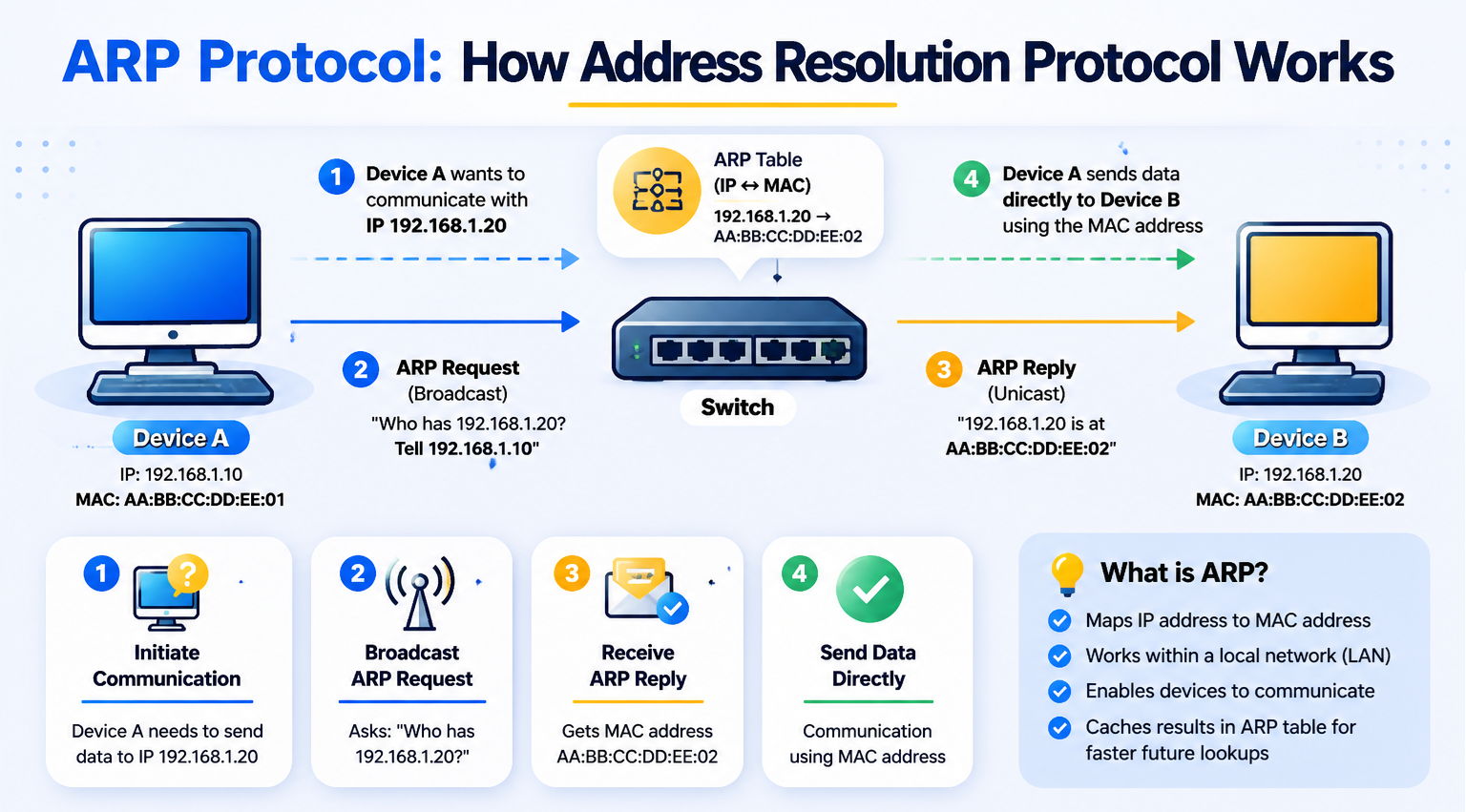
This process is fast and usually invisible to users. It happens every time a new device is contacted within a network.
ARP Request and ARP Reply
ARP communication consists of two main messages: request and reply.
- ARP Request: A broadcast message asking "Who has this IP address?"
- ARP Reply: A unicast response containing the MAC address of the requested IP
The request is sent to all devices, but only the correct device responds. This ensures efficient and accurate communication within the network.
ARP Cache
To improve efficiency, devices maintain an ARP cache. This is a temporary table that stores recently resolved IP-to-MAC mappings.
Instead of sending repeated ARP requests, the device can quickly look up the MAC address in the cache. Entries expire after a certain time to ensure accuracy.
- Stores IP and MAC address mappings
- Reduces network traffic
- Speeds up communication
- Entries are automatically updated or removed
Types of ARP
ARP has several variations that serve different purposes in networking environments.
- Standard ARP: Resolves IP to MAC within a local network
- Reverse ARP (RARP): Maps MAC address to IP address (largely obsolete)
- Gratuitous ARP: A device announces its IP-to-MAC mapping to update others
- Proxy ARP: A router responds to ARP requests on behalf of another device
ARP and Network Devices
ARP is primarily used within local networks, but it also interacts with devices like routers when communication extends beyond the local network.
If a device wants to send data outside its local network, it forwards the data to the default gateway. The MAC address of the gateway is resolved using ARP, allowing the router to handle further routing.
This process works alongside concepts like routing and Network Address Translation to ensure data reaches its destination.
ARP vs DNS
ARP is often confused with DNS, but they serve different purposes.
| Feature | ARP | DNS |
|---|---|---|
| Purpose | IP to MAC mapping | Domain to IP mapping |
| Scope | Local network | Global internet |
| Example | 192.168.1.1 → MAC | example.com → IP |
To understand DNS in detail, you can explore Domain Name System and DNS lookup process.
Security Risks of ARP
While ARP is essential, it does not include built-in security. This makes it vulnerable to certain attacks.
- ARP Spoofing: An attacker sends fake ARP messages to link their MAC address with another device's IP
- Man-in-the-Middle attacks: Intercepting communication between two devices
- Network disruption: Incorrect mappings can break communication
These risks highlight the importance of network security tools like firewalls and secure network configurations.
Best Practices for ARP Security
To reduce risks associated with ARP, network administrators follow certain best practices.
- Use static ARP entries for critical systems
- Enable network monitoring tools
- Implement secure switching features like Dynamic ARP Inspection
- Segment networks to limit attack impact
Frequently Asked Questions
- Does ARP work on the internet?
No. ARP works only within local networks. For internet communication, routing and DNS are used. - Is ARP used in IPv6?
No. IPv6 uses a different protocol called Neighbor Discovery Protocol instead of ARP. - What happens if ARP fails?
The device cannot find the MAC address, so communication within the local network fails. - Can ARP be disabled?
ARP is essential for network communication, so it cannot be fully disabled in normal operation. - How is ARP different from routing?
ARP resolves addresses within a local network, while routing moves data between different networks.
Conclusion
ARP is a foundational protocol that enables communication within local networks by linking IP addresses to MAC addresses. It operates silently but plays a critical role in ensuring that data reaches the correct device.
Understanding ARP helps build a strong foundation in networking and complements topics like IP addressing, MAC addressing, and network layers. Together, these concepts form the backbone of modern network communication.