

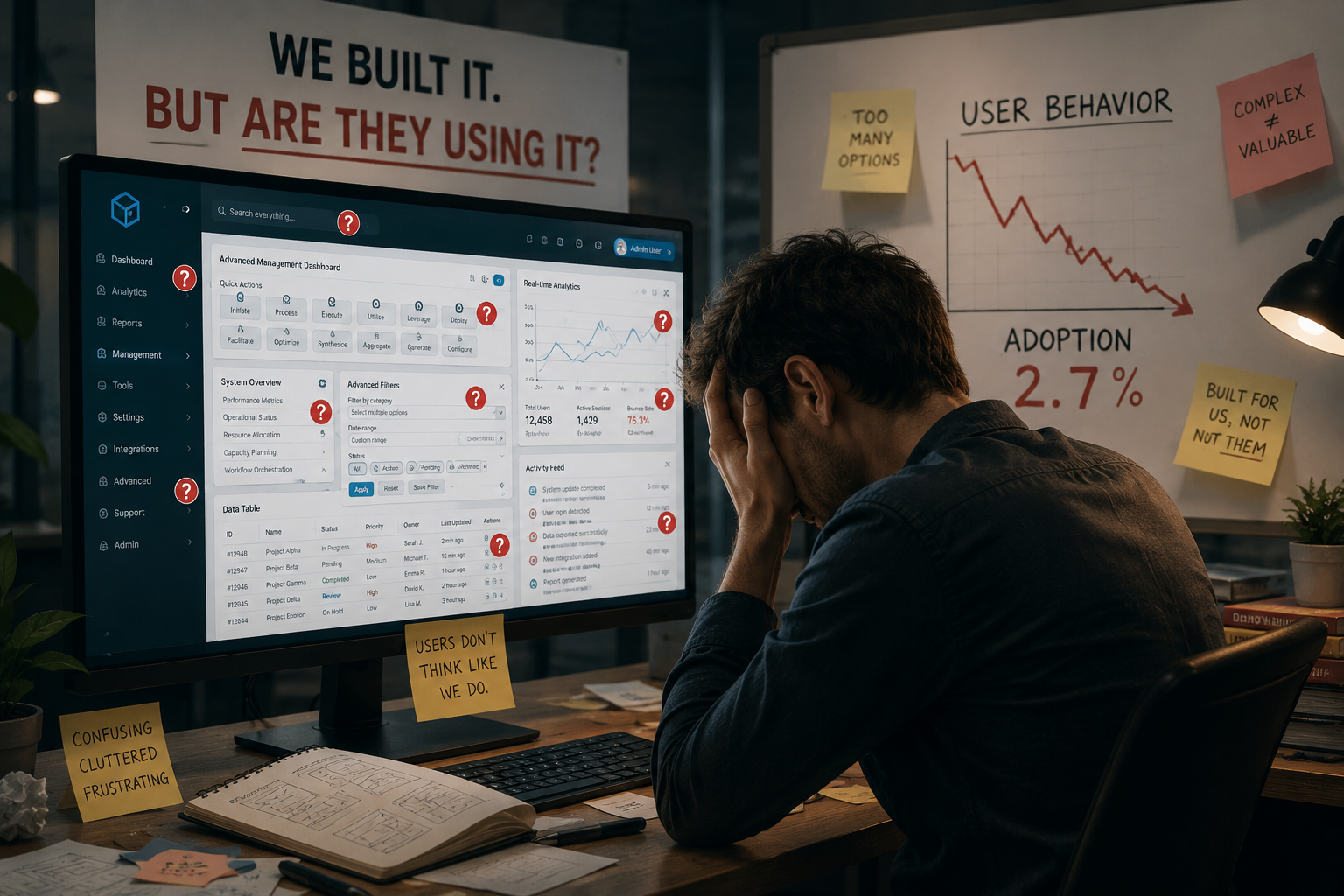
I watched a product demo last month where the team spent forty minutes walking through features. There were dozens of them. Integrations and automations and customization options and reporting dashboards. The product could do almost anything. The problem was that nobody in the room could figure out how to do the one thing they came to do without asking for help three times. The features were impressive on a comparison chart. The experience was terrible. That product is losing to a competitor that does about twenty percent of what this product does, but does it so smoothly that users never have to think about the interface at all.
The assumption that more features means more value is one of the most expensive mistakes in digital product development. Feature counts show up on marketing pages and sales decks and competitive analyses. Teams build roadmaps packed with additions. Engineering resources pour into new capabilities. And yet the products that dominate their categories are rarely the ones with the most features. They are the ones that nail the experience so well that users forget the product is even there. Features represent potential. UX determines whether that potential ever gets realized. A feature a user cannot find or cannot use or cannot understand is not a feature. It is wasted engineering effort that makes the product harder to use while delivering zero value.
What UX Actually Determines
User experience gets reduced to visual design in too many conversations. It is about making things look good. That definition is not wrong so much as incomplete in ways that lead to bad decisions. UX is every interaction between a person and a product. It is how fast pages load and how clear navigation works and how obvious the next step is. It is whether error messages help or blame. It is whether the user feels confident or confused at every moment from first arrival to task completion.
A product with strong UX does not need to be beautiful. It needs to be clear. The user understands where they are and what they can do next and what will happen when they do it. That clarity reduces the mental effort required to use the product. When UX works, the product disappears. The user stops thinking about buttons and menus and focuses entirely on their goal. When UX fails, the product becomes the problem. Every interaction requires conscious effort. Every step feels uncertain. The user is fighting the interface instead of using it.
The definition matters because it determines what teams optimize. Define UX as visual polish and you get beautiful products that are frustrating to use. Define UX as goal achievement clarity and you get products that work. The second definition correlates with business outcomes. The first correlates with design awards and high bounce rates.
Why Teams Keep Falling Into the Feature Trap
The feature trap works like this. A competitor adds something, so you add it. A customer requests something, so you build it. Sales needs something to close a deal, so you ship it. Each individual decision makes sense at the time. The cumulative result is a product that does many things adequately and nothing exceptionally well. The interface gets cluttered. Navigation gets confusing. Onboarding gets overwhelming. The product gains capabilities and loses usability, and the usability loss costs more than the capabilities gain.
Several forces push teams toward this trap. Roadmaps reward shipping new things over improving existing ones. Marketing prefers announcing additions to announcing refinements. User feedback channels surface feature requests more loudly than complaints about existing friction. Each force alone is manageable. Together they create a powerful incentive to keep adding while deferring the harder work of making what already exists work better.
The products that escape this trap evaluate features differently. Not by whether they can be built, but by whether users will actually use them given how they currently interact with the product. That question shifts focus from potential value to realized value. Features that would sit unused or cause confusion do not get built regardless of how reasonable they look in isolation. Resources go instead toward making existing capabilities more discoverable and more reliable and more intuitive. The product does fewer things. The things it does work consistently. Users prefer that trade every time.
Predictability Creates Trust
Trust in digital products comes from predictability. A button that works the same way everywhere. Information that appears where users expect it. A system that responds to input without surprises. When users can predict what will happen, they feel safe. They explore. They try new features. They push deeper into the product because they trust that the environment will behave consistently.
Poor UX destroys trust through inconsistency. A button that does one thing on this screen and something different on that screen. Navigation elements that shift or vanish. Errors that appear without explanation or solution. Each inconsistency is small. Together they teach users that the product cannot be trusted. Users stop exploring. They stop trying new features. They stick to the narrow path they know works, and the product's potential value goes unrealized not because users rejected it but because they never felt confident enough to discover it.
Strong UX rebuilds trust through deliberate consistency. Patterns repeat. Hierarchy stays stable. Language stays consistent. Users build accurate mental models of how the system works. Predictability reduces the perceived risk of trying new things. Users find more value not because the features are new but because they finally understand them well enough to use them. The difference is not in the features. It is in the experience of accessing them.
The Metrics That Prove UX Matters
The connection between UX and business outcomes shows up in metrics teams already track. Bounce rates measure how many users arrive and immediately leave, often because they cannot quickly determine what the product does or how to start. Time-on-task measures how long basic actions take, with longer times indicating friction and confusion. Conversion rates measure completed actions, with drops often tracing to unclear pathways or unexpected obstacles. Support ticket volume measures how often users need human help, with high volumes indicating the product fails to explain itself.
Every one of these metrics responds to UX improvements faster than to feature additions. A faster page load drops bounce rates without adding any new capability. Clearer navigation cuts time-on-task without changing what the product does. Better calls to action improve conversion by making next steps obvious. Clearer error messages reduce support volume by helping users fix issues themselves. These improvements compound across the entire user base. Small friction reductions per user aggregate into significant performance gains.
The reverse is also true. Adding features without UX investment degrades these metrics. New capabilities add complexity. More complexity increases cognitive load. Higher cognitive load pushes bounce rates up and conversion down and support volume higher. The feature meant to create value instead destroys it by making the product harder to use. Measuring UX impact alongside feature impact is the only way to know whether changes actually help users or just add weight.
Technology That Feels Human
Digital products are tools, but they are also environments where people spend significant portions of their day. The quality of that environment matters. A product that feels hostile or confusing creates stress that builds across interactions. A product that feels natural and supportive creates comfort that builds loyalty. The difference is not in features or visual polish. It is in whether the product respects human cognitive limits.
Good UX makes technology feel human by removing friction between intention and action. Users should not need instructions for basic tasks. They should not need to remember where things are across sessions. They should not need to guess what happens next. When a product meets these expectations, it fades into the background. Users stop experiencing the product and start experiencing only what they accomplish through it. That transparency is the goal. The product becomes invisible. Only the task remains.
Bad UX does the opposite. It constantly reminds users of its presence through friction and confusion. Every interaction requires attention to the tool rather than the task. Users remain aware of the product as something to overcome rather than something to rely on. That awareness breeds frustration and eventually abandonment. Features that looked great in development never get used because using them requires more effort than users are willing to spend.
UX Requires Continuous Investment
Many organizations treat UX as a phase. Design resources get applied during initial creation and maybe during major redesigns. Between those moments, UX receives minimal attention while feature development continues uninterrupted. This approach misunderstands how UX quality degrades.
UX erodes gradually as features accumulate. Each addition introduces new elements and new patterns and new concepts. Without continuous attention to coherence, these additions slowly destroy the clarity that made the initial product usable. Internal teams often miss this degradation because they experience the product differently than new users. They know the history. They know where things are because they put them there. New users encounter only the accumulated complexity without any of the context that makes it navigable. They feel lost, and they leave.
Sustained UX quality requires ongoing investment alongside feature development. New features must be evaluated for how they affect overall coherence, not just for what they add. Navigation must be reviewed and simplified as the product grows. Onboarding must evolve as user behavior reveals where people actually get stuck. These activities do not produce visible additions to the feature list. They produce sustained usability that preserves the value of every feature already built.
The products that win in competitive markets are not the ones with the most features. They are the ones that remain usable as they grow. That requires treating UX as continuous practice, not a one-time project. The investment never ends because the product never stops changing. Each change creates new opportunities for confusion or clarity. Teams that choose clarity consistently build products users trust and return to. Teams that prioritize features over coherence build products users eventually abandon for something simpler. The market does not reward who builds the most. It rewards who builds what people can actually use.






Comments (0)
No comments yet
Be the first to share your thoughts!
Post Your Comment Here: